Amarillo Cost & Decision Guide
Tree Trimming Cost in Amarillo, TX: 2026 Price Guide
Published September 8, 2026 · Last reviewed · Amarillo, Canyon & Bushland, TX
The short answer
As of September 2026, tree trimming in Amarillo, TX runs $100–$1,200 per tree across the full local range, with most typical trims on an established yard tree landing between $250 and $800. Where a given tree falls depends on its height and canopy size, how much is coming off, and how close it stands to the house or a power line.
Panhandle Tree Care · (806) 555-0142 · matching Amarillo-area homeowners with independent local tree service providers.
Trimming quotes in Amarillo range more than tenfold from the bottom to the top, and almost none of that spread is about the hourly value of a crew’s time. It is about the tree: how tall it is, how much wood has to come out of it, and whether every limb can be dropped into the yard or has to be lowered on a rope over the roof. Once you understand what moves the number, two very different quotes for the “same” job usually stop looking like a scam and start looking like two different jobs, and you can tell which one actually describes the work your tree needs.
What moves the price
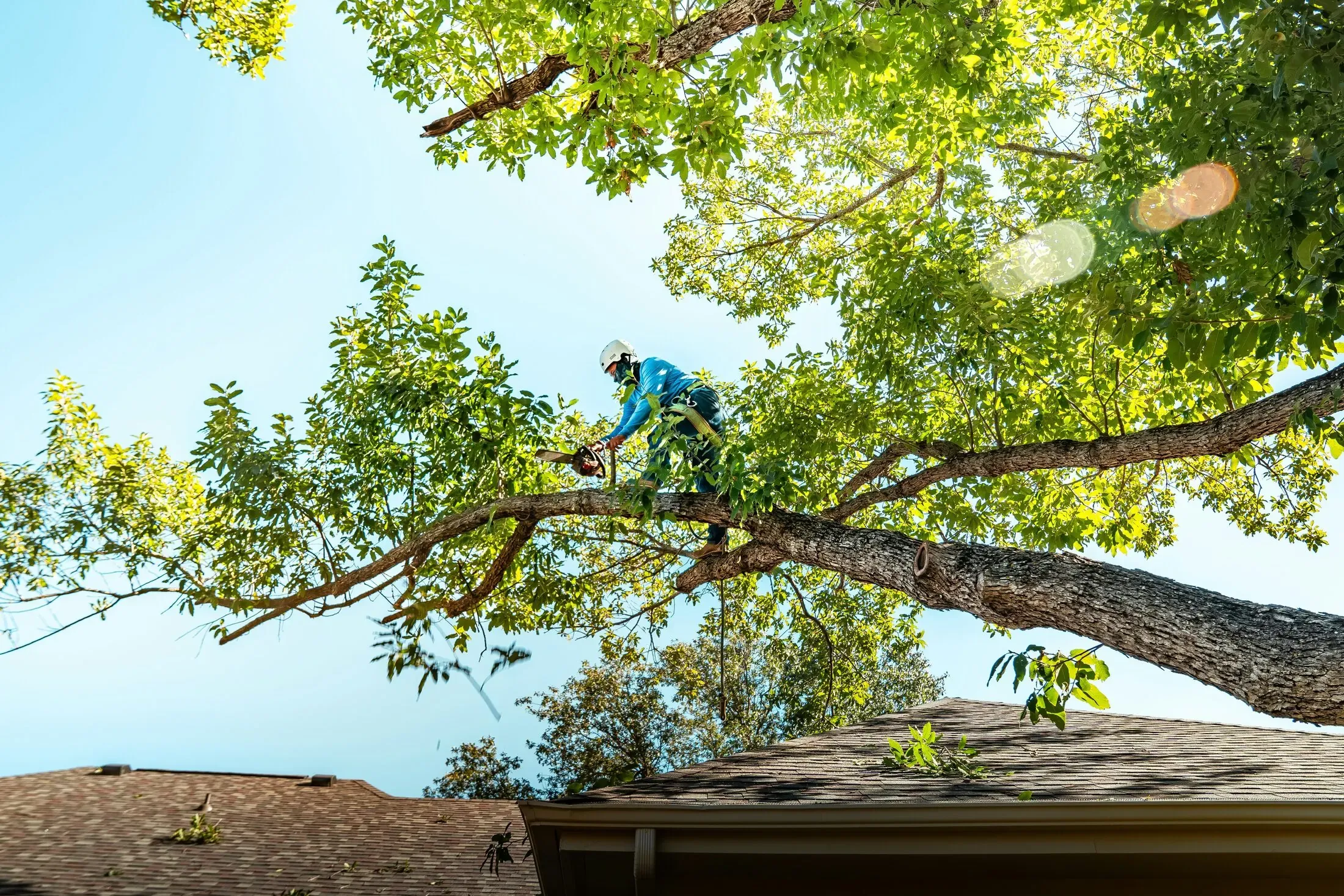
Tree height and canopy size. The single biggest factor. A twelve-foot ornamental can be trimmed from the ground or a short ladder. A sixty-foot Siberian elm means a climber, rigging, and a crew on the ground, and every cut takes longer to make and longer to get down.
How much is coming off. Removing a handful of dead limbs is a short visit. Reducing a whole canopy that has not been touched in fifteen years is a day of work and a large pile of brush. Ask the estimator to say what is coming off in feet or percent so that “a trim” means something.
Access and what the tree stands over. A tree in an open front yard with the truck at the curb is the easy case. A tree hemmed in by the house, a fence, a pool, or a neighbor’s roof means limbs have to be rigged down piece by piece rather than dropped. Anything within reach of a power line changes the job entirely; Xcel Energy handles clearance around its lines, and a private crew should not be working near an energized conductor.
How long since it was last trimmed. A tree on a regular cycle needs light work each time. A tree that was last pruned when the house was built has years of dead wood, crossing limbs, and weight to correct, and the first visit is always the expensive one. Later visits, on a tree that has been brought back into shape, are shorter and cheaper.
Debris hauling. Some providers fold chipping and hauling into the per-tree price. Others quote it as a separate line, and in Amarillo that line runs about $100–$200+. A quote that leaves the brush on the driveway is not really cheaper, and a big elm reduction produces far more brush than most homeowners expect.
Tree trimming prices in Amarillo
As of September 2026, the published ranges from Amarillo tree services come out like this:
| Job size | Amarillo range (per tree) |
|---|---|
| Small ornamental or young tree, light cleanup | From about $100 |
| Typical established yard tree | $250–$800 |
| Large mature tree, full canopy work near a structure | Toward $1,200 |
| Full local range | $100–$1,200 |
| Debris hauling, if quoted separately | $100–$200+ |
One caution about the table. These are per-tree ranges, and the reason they are ranges rather than prices is that two large Siberian elms on the same street can be very different jobs. The one over open lawn that gets deadwooded every few years is not the one that leans over the neighbor’s garage and has never been touched. Get a written quote for your tree; use the table to know whether that quote is in the neighborhood.
Types of trimming, and what to ask for
“Trim the tree” can mean six different things. Knowing which one you want is the difference between a quote you can compare and a quote you cannot.
Crown cleaning. Removing dead, dying, diseased, and broken limbs, plus crossing branches that rub. The most common job on an established Amarillo tree, and the one to ask for if you mostly want it safer and tidier without changing its shape.
Crown thinning. Selectively removing live branches through the canopy to let wind and light pass. Reduces the “sail” effect on a dense tree without cutting it shorter. Done well, you should barely notice; done badly (stripping the interior and leaving tufts at the ends, sometimes called lion-tailing) it makes the tree weaker.
Crown raising. Removing the lower limbs to clear a roof, a driveway, a sidewalk, or a line of sight. Common along older streets in Wolflin and Puckett where mature trees have grown down into the driveway.
Crown reduction. Shortening the tree or one side of it by cutting limbs back to a smaller side branch that can take over as the new tip. The right answer for a Siberian elm that has grown too big for its space or hangs too far over a roof. The key phrase is “back to a lateral”: the cut lands where a living branch continues, not at an arbitrary stub.
Deadwooding. Removing only the dead limbs, often above a certain size. Sometimes bundled into crown cleaning, sometimes quoted alone for a brittle tree that sheds.
Structural pruning of young trees. Shaping a tree in its first years so it grows one dominant trunk and well-spaced limbs with strong unions. Cheap when the tree is small, and the reason many big-tree problems exist is that nobody did it. Honey locust and hackberry benefit the most.
The cut to refuse: topping
Topping is cutting every limb back to a stub at a chosen height, with no regard for where the cuts land. It is the cheapest trim you can buy because it is fast and requires no judgment.
It is also the most expensive over time. A topped tree responds with a dense flush of sprouts from the stubs, each attached only to the outer bark rather than anchored in the wood. Those sprouts grow fast, weak, and heavy. The stubs themselves cannot heal and begin to decay. Within a few seasons you have a tree that is as tall as it was, with a canopy made of poorly attached limbs sitting on rotting stubs, and it sheds more in every storm than the original tree did. On a Siberian elm, already brittle and already prone to shedding, topping is the single worst thing you can do, and the older neighborhoods of Amarillo are full of elms that were topped decades ago and have been dropping limbs ever since.
If an estimator offers topping as the budget option, that is a reason to get a different estimate.
Timing in Amarillo
Late winter is the main window. Pruning during dormancy, before the buds swell, lets the tree seal its cuts as growth begins and gets the work done before the Panhandle’s primary hail season, which runs March through early May and peaks in April and early May. A tree that goes into hail season with its dead wood removed and its weight reduced comes out of it with fewer broken limbs.
After a storm, a light corrective trim is fine any time. Hanging limbs, torn branches, and split tips should come off when they happen, whether that is May or October. The secondary hail season in September and October brings smaller stones and isolated storms, so a fall cleanup is often needed too.
Avoid heavy summer pruning. A tree in July is already fighting drought, days when the humidity falls below 15 percent, and heat. Taking a large share of its canopy at that point is a double stress. Small corrective cuts are fine; a full reduction should wait for dormancy.
Trimming versus removal
A tree that is sound in the trunk and at the major unions can almost always be trimmed into a safer shape for less than it costs to remove it. A tree with a split trunk, conks at the base, or a lean with lifted soil cannot be pruned back to safety, and trimming it only delays the bill. Removal in Amarillo runs about $400–$2,000+ per tree, so the difference matters. Our removal-versus-trimming guide walks through that decision, and the symptom guide helps you sort what you are seeing before an estimator arrives.
Where these figures come from
The figures on this page are the published per-tree ranges from Amarillo tree service companies: one company publishes a full range of $100–$1,200, another puts a typical trim at $250–$800, and a local blog puts separately quoted hauling at $100–$200+. There is no hourly or per-limb figure on this page because no Amarillo provider publishes one, and we would rather leave a gap than invent a number. Our methodology note explains how price pages on this site are compiled and how often they are reviewed.
Red flags on a trimming quote
- Topping offered as the budget option. See above.
- Climbing spikes on a tree that is being kept. Spurs punch holes through the bark every step and belong only on a tree being removed. A climber on a rope and saddle does not need them.
- No insurance certificate. Texas does not license tree services, so the certificate of general liability and workers’ compensation is the document that protects you if a limb goes through the roof or a worker is hurt in your yard. Ask for it before work starts.
- A “city license number.” The City of Amarillo does not issue contractor ID numbers. A company presenting one is not presenting a credential.
- A price from the curb. An estimate given without walking under the tree is a guess, and the price tends to change once the crew arrives.
Ready to get a quote? Tell us about the tree and we will match you with an independent Amarillo tree service, or read more about what trimming covers on the tree trimming and pruning page.
FAQ
Tree Trimming Cost in Amarillo, TX: 2026 Price Guide: Questions Amarillo Homeowners Ask
How much does it cost to trim a tree in Amarillo?
As of September 2026, tree trimming in Amarillo runs $100–$1,200 per tree, and most typical trims land between $250 and $800. A light cleanup on a small ornamental sits at the low end; full canopy work on a large, long-neglected tree near the house is what pushes a quote toward $1,200.
Is debris hauling included in a trimming quote?
Sometimes, and you should ask, because when it is quoted separately in Amarillo it runs about $100–$200+. A quote that looks cheap may leave the brush in a pile on your driveway, so confirm in writing that cutting, chipping, and hauling are all covered.
When is the best time of year to trim trees in Amarillo?
Late winter, while the tree is dormant and before the March-through-early-May hail season, is the best window for most Amarillo trees. Light corrective trims to remove hanging or broken limbs are fine any time after a storm, but heavy pruning in July heat adds stress to a tree that is already fighting drought.
Why is topping cheaper, and why should I say no to it?
Topping is cheaper because it is fast: the crew cuts every limb back to a stub at one height with no thought to where the cuts land. The tree answers with a thicket of weak, fast-growing sprouts, the stubs decay, and within a few years you have a tree that sheds more limbs in storms than it did before, especially if it is a Siberian elm.
Do I need a permit to trim a tree in Amarillo?
The City of Amarillo's published permit exemption list does not address tree work either way, so the honest answer is to ask Building Safety at 806-378-3041 before you assume. For trees near power lines, Xcel Energy handles line clearance, and a private crew should not be working within reach of an energized line.
Should I trim or remove a tree that keeps dropping limbs?
If the trunk and the major unions are sound, deadwooding and weight reduction usually solve a limb-shedding tree for a fraction of the cost of removal. If the tree has a split, a rotating root plate, or decay at the base, trimming only delays the removal; the diagnostic guide on this site walks through how to tell the two apart.
Keep reading
Related Amarillo tree guides
Ready for a real quote from a local Amarillo tree service?
Tell us what your tree is doing and we’ll match you with an independent local provider serving Amarillo, Canyon, and Bushland. No obligation to hire.