Amarillo Cost & Decision Guide
Is My Tree Dying or Dangerous? A Symptom Guide for Amarillo Yards
Published September 8, 2026 · Last reviewed · Amarillo, Canyon & Bushland, TX
The short answer
As of September 2026, the Amarillo, TX rule of thumb is this: structural signs (a cracked or split trunk, a new or worsening lean, large fungal conks at the base) mean call a tree service now, especially if the tree can reach a house or a power line; canopy dieback over roughly a third of the crown or fresh storm damage means get an inspection soon; slow growth or some yellowing with nothing structural behind it is usually routine care, not an emergency.
Panhandle Tree Care · (806) 555-0142 · matching Amarillo-area homeowners with independent local tree service providers.
The hard part is not spotting that something is off with the tree. It is knowing which “off” means you should be on the phone today, which means a look in the next few weeks, and which is just a Panhandle tree having a Panhandle summer. This page sorts the symptoms into those three buckets, explains what an inspection involves, and tells you what it costs if the answer is trimming or removal. One idea runs through all of it: dying and dangerous are two different questions, and a tree can be one without the other.
Before you call anyone, spend ten minutes on the six-step walk-around at the top of this page. A lean or a crack that is measurably worse between two dated photos is the single most useful thing you can show the provider we match you with.
Symptom by symptom
Cracks and splits in the trunk or major limbs
A vertical crack running down the trunk, a split where two big stems meet, or a limb torn partway from the trunk but still attached: these are structural failures in progress, not signs of poor health. The tree may be perfectly green; it does not matter.
Look closely at unions, where a large limb or a second trunk meets the main stem. A wide, U-shaped union is strong. A narrow V-shaped union with bark folded into the seam (included bark) has no real wood connection through the middle, and it is the most common place for a big Siberian elm or a multi-trunk hackberry to split in a storm.
What it means: call now if the crack is in the trunk or a major limb and the tree can reach a structure, a driveway, or a line. Cabling can sometimes hold a cracked union, but that is an arborist’s call, not a wait-and-see.
Leaning: old and stable, or new and moving
Plenty of Amarillo trees lean. One that has leaned the same amount for twenty years and built thick wood on the tension side is usually fine.
A new lean is different, and so is an old lean getting worse. The tell is at the base: soil lifted, cracked, or mounded on the side opposite the lean means the root plate is rotating and the tree is falling over, however slowly. Newly exposed roots on the tension side say the same.
What it means: a settled lean with undisturbed soil is routine. A new, worsening, or lifted-soil lean is call now; if the tree could reach the house or a line, treat it as an emergency and keep people and cars out from under it.
Mushrooms, conks, and shelf fungus at the base
Fungus on the trunk, the root flare, or the soil right against the base is not cosmetic. Mushrooms are the fruiting bodies of a fungus whose body is somewhere else, and here the somewhere else is inside the wood. Shelf fungus and hard, woody conks on the lower trunk point to root rot or butt rot: decay in the part of the tree that holds everything else up.
You cannot judge the extent from outside. A tree can have a thick shell of sound wood and stand for years, or be mostly punk inside a ring of bark. Only probing and sounding tells you which.
What it means: large conks or repeated mushroom growth at the base is call now, particularly near a structure. Removing the fungus does not remove the decay.
Cavities and a hollow sound
An open cavity, a hole where a limb was lost years ago, or a dull, drum-like sound when you tap the trunk all point to internal decay. Cottonwoods are the classic Amarillo example: a big Bushland cottonwood can look magnificent while carrying a trunk that is mostly air.
A cavity is not automatically a death sentence. Trees wall off decay, and a hollow tree with a thick, sound shell can stand. The questions are how much shell, where the cavity sits, and what the tree stands over.
What it means: get an inspection soon; sooner if the cavity is at the base or the tree leans toward something valuable.
Dead wood and canopy dieback
Every mature tree carries some dead branches, and Siberian elms shed small dead wood constantly. Routine deadwooding handles that.
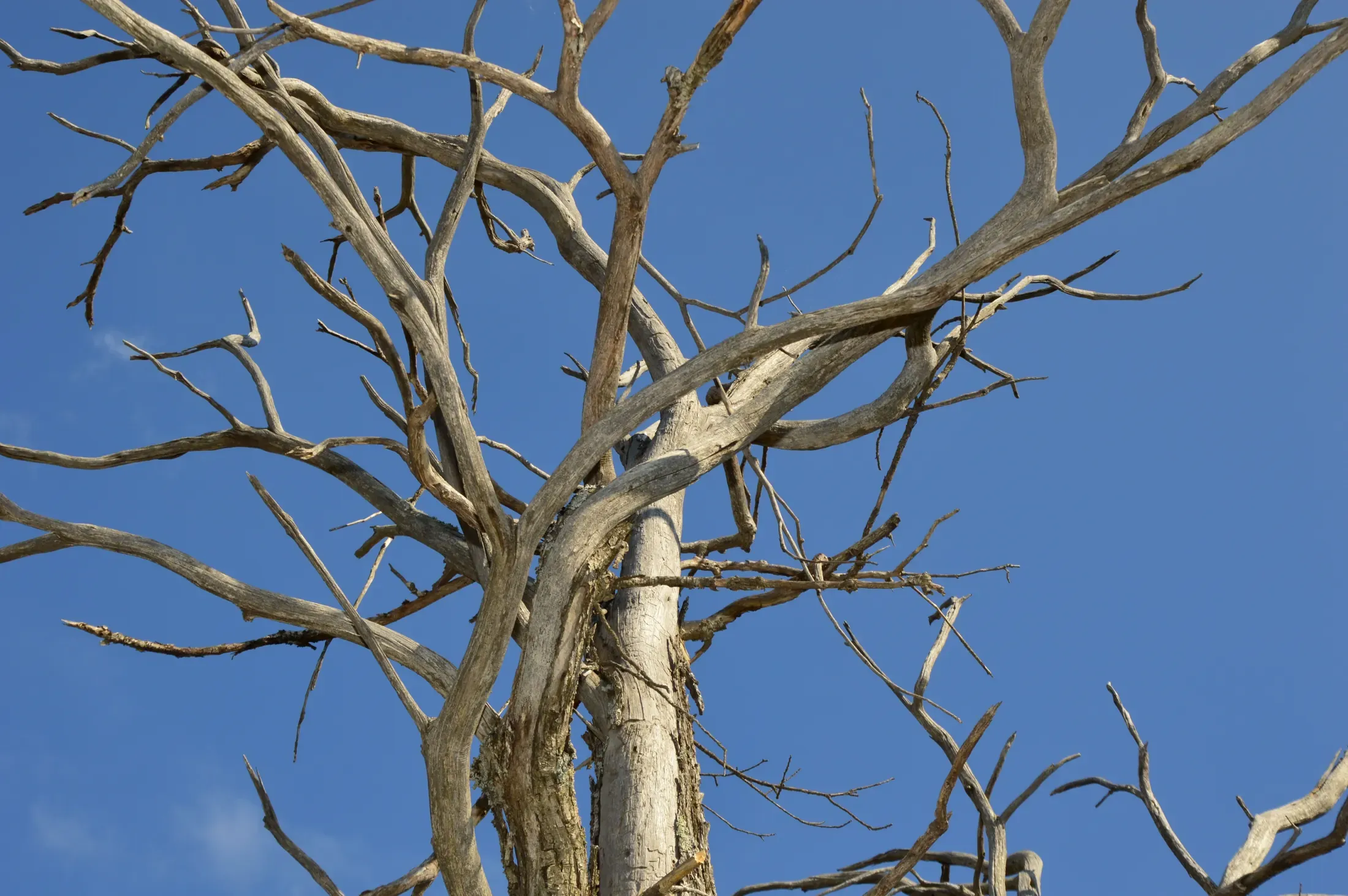
The pattern to watch is dieback: dead branches concentrated at the top of the crown and the tips of the limbs, or a whole side that failed to leaf out. Top-down dieback usually means the roots cannot supply the farthest growth, which points to root damage, drought, construction, or a soil problem. One-sided dieback often traces to a root injury on that side.
What it means: scattered dead wood is routine care and a reason to schedule trimming. Dieback across roughly a third or more of the crown means get an inspection soon; big dead limbs over a roof or a driveway move it to call now.
Bark falling off or peeling
Some bark shedding is normal: some species slough bark as they grow, and sun-scald on the southwest side of a thin-barked young tree will lift a patch without killing it.
Bark falling away in sheets from a mature trunk, or bare wood with sawdust-like frass, boring holes, or fungal mats underneath, is different. That is dead cambium, the living layer under the bark, and a tree cannot recover that section of trunk.
What it means: small patches on the sun side of a young tree are routine. Sheets coming off a mature trunk with bare or discolored wood underneath means get an inspection soon.
Sudden leaf drop or early browning versus normal Panhandle stress
This is where more Amarillo homeowners worry than they need to. The National Weather Service describes a local climate where relative humidity occasionally drops below 15 percent and temperatures swing 50 to 60 degrees inside 12 hours, on about 19.71 inches of precipitation a year. Trees here shed leaves early and scorch at the margins because they are cutting their losses, not dying.
The distinction is what happens next. A stressed tree leafs out normally the following spring. A tree in real trouble leafs out late, thin, or only on part of the crown, and each year the live part shrinks. Sudden browning of an entire tree mid-season, with the dead leaves staying on, is the exception worth a call, because it can indicate a root or vascular failure.
What it means: early leaf drop and margin scorch in a dry summer are routine; water deeply. A whole tree browning at once, or a spring that comes in thin, means get an inspection.
Sprouts along the trunk
A flush of small shoots along the trunk or at the base of big limbs, called water sprouts or epicormic growth, is a stress response: the tree is pushing emergency growth from dormant buds because the canopy above is not doing its job. You see it most after topping, after storm damage, and on trees dying back from the top. By itself it is not dangerous; it is a signal to look harder.
What it means: routine if the rest of the walk-around is clean. Combined with dieback, cavities, or fungus, it strengthens the case for an inspection.
Lifted roots and girdling roots
Two different problems. Roots heaving out of the ground on one side, with cracked or mounded soil, mean a rotating root plate and belong in the call-now bucket above.
Girdling roots are slower. A root that grew in a circle around the trunk, often from a tree planted too deep, tightens as the trunk expands and strangles the flow between roots and crown. Look for a trunk with no visible flare at the ground, or a root crossing the base like a belt. The symptom above is thinning and dieback on the side being choked.
What it means: girdling roots are get an inspection; an arborist can sometimes cut the offending root. Lifted roots under a leaning tree are call now.
What is different about Amarillo trees
The symptoms above are universal. What makes them read differently in Potter and Randall County is the ground, the weather, and the species people planted.
Caliche keeps roots shallow and wide. Across much of the county, a chalky calcium-carbonate hardpan sits not far below the surface, and the city’s residential foundation manual notes that most homes here sit on slab-on-ground foundations, many over expansive clays. Roots that cannot go down go out. A tree anchored by a shallow, wide plate rather than a taproot is more sensitive to soil that dries and cracks, to trenching near the trunk, and to wind, so lifted soil under a lean shows up sooner and matters more. Our caliche and tree health guide covers what this means for watering.
Drought stress is the baseline. Days with humidity below 15 percent pull water out of leaves faster than shallow roots in dry soil can replace it. Margin scorch and early leaf drop are the normal condition of a tree here that is not watered deeply. The mistake is to assume that means dying; the opposite mistake is to see it every year and never notice the crown is a little thinner each spring.
Temperature swings crack bark. A 50 to 60 degree drop inside half a day is how sun-scald and frost cracks happen on the south and southwest side of trunks. A single crack on the sunny side of a young, thin-barked tree is often this rather than a structural failure; the same crack on a mature trunk deserves a closer look.
Hail shreds canopies in spring. The Panhandle has a primary hail season from March through early May, peaking in April and early May, and a smaller secondary season in September and October. A canopy that looks ragged and half-bare after a hailstorm is not dying; it was stripped, and most trees push a second flush. What hail leaves behind is hanging limbs and torn bark that becomes an entry point for decay, which is why a light corrective trim after a bad storm is worth scheduling.
Siberian elms shed limbs; cottonwoods hollow out. The big older-neighborhood tree in Wolflin, Puckett, and Sleepy Hollow is commonly the Siberian elm: brittle, prone to included-bark unions, and a habitual limb-dropper, so every one over a roof deserves a periodic look at its unions and dead wood. Cottonwoods, common on Bushland acreage, grow fast, lose big limbs, and decay from the inside with age; a hollow sound on a cottonwood is the expected finding, and the question is how much shell is left. Hackberry and honey locust are sturdier but form the same tight unions if never structurally pruned young.
Dying and dangerous are different questions
A tree that is dying is losing the ability to feed itself: the canopy shrinks each year, the leaves come in thin, the sprouts along the trunk multiply. Whether that is a problem depends entirely on where it stands. A dying hackberry at the back of a Bushland pasture can stand for another decade and be a fine home for woodpeckers. Nobody has to do anything.
A tree that is dangerous is one likely to fail, in whole or in part, with something to hit when it does. Health is almost beside the point. The greenest Siberian elm in Wolflin, with an included-bark union thirty feet up and the bedroom under one of the two stems, is dangerous. The dying tree in the pasture is not.
So ask two separate questions:
- Is the tree failing? Cracks, splits, lean with lifted soil, conks, cavities, and dieback answer this one.
- What can it hit? The house, the garage, the neighbor’s roof, the driveway, the street, the service line.
A “yes” on the first with a real answer on the second is call now. A “yes” on the first over open lawn is get an inspection, which may conclude the tree can stay and be watched. A “no” on the first is routine care whatever it stands over.
What an inspection involves, and who to ask
Texas does not license tree services, and the City of Amarillo does not issue contractor ID numbers, so a “city license number” on a business card is a warning sign rather than a credential. What you can ask for is a certificate of general liability insurance and workers’ compensation coverage, and the ISA Certified Arborist credential.
The ISA credential is voluntary, and it is the only widely recognized sign that the person looking at your tree has studied tree biology, decay, and risk rather than just cutting. For a keep-or-remove decision it is the qualification that matters; someone excellent at taking a tree down is not necessarily the right person to say whether it needs to come down.
Think too about who is paid by the answer. A company that only sells removal will recommend removal, because that is the tool they have. If you would rather keep the tree, ask whether the company also does pruning and cabling, or get an assessment from someone not bidding on the work.
A proper inspection typically covers:
- The same walk-around you did, with a trained eye on unions, root flare, and lean.
- Sounding the trunk with a mallet and probing cavities; sometimes a drill or resistance tool to measure sound wood.
- The site: what the tree can reach, soil condition, recent trenching, irrigation.
- A written opinion on whether the tree can be kept, kept with work, or should be removed, and how urgent that is.
Ask for that opinion in writing. It is what you want on file if the tree is on a property line, and it makes a later quote make sense.
When trimming or cabling can save a tree, and when removal is the answer
Trimming can address scattered dead wood, weight on long limbs over a roof, a dense sail-like canopy, hanging storm-broken limbs, and a young tree’s structure before bad unions become big ones. Deadwooding and crown reduction are the standard answers for a Siberian elm that sheds limbs but is otherwise sound. The trimming cost guide covers what each cut involves.
Cabling and bracing is a service some Amarillo tree services offer: steel cable or threaded rods installed to support a weak union or a split that has not fully failed, so a tree with one structural flaw can be kept. It is not a cure for decay. There is no published local price for it; ask the provider for a written figure.
Removal is the answer when the trunk or root plate is compromised (major decay at the base, a rotating root plate, a split trunk), when dieback has passed the point of recovery, or when a structural flaw over a target is one no amount of pruning fixes. Our removal-versus-trimming guide walks through that judgment.
What it costs if the tree does need to come out
As of September 2026, tree removal in Amarillo runs about $400–$2,000+ per tree. The low end is a small ornamental in an open yard; the high end is a large tree next to a structure or a power line, where every piece has to be rigged down instead of felled. The tree removal cost guide breaks that span into size tiers.
If the answer is trimming instead, Amarillo tree services quote roughly $100–$1,200 per tree, from a light cleanup on a small tree to full canopy work on a large mature one. The trimming cost guide has the detail.
Both are per-tree ranges that depend on access and on what the tree stands over more than anything else. A tree already on the ground with clear access can cost less than a standing removal; one on the house that needs a crane costs more. Get the number in writing before anyone starts.
What to do next
A cracked trunk, a new lean, lifted soil, or conks at the base on a tree that can reach something: treat it as urgent, keep people and vehicles out from under it, and get a tree service out. If a limb is down on a line, call Xcel Energy first and keep a private crew away from anything energized.
Dieback, a cavity, peeling bark on a mature trunk, or storm damage without an immediate target: schedule an inspection in the next few weeks and ask for an ISA Certified Arborist.
A tree just having a hard Panhandle summer: water it deeply, take your dated photos, and look again next spring.
Whichever bucket you are in, tell us about the tree and we will match you with an independent Amarillo tree service. Photos help.
FAQ
Is My Tree Dying or Dangerous? A Symptom Guide for Amarillo Yards: Questions Amarillo Homeowners Ask
Can a tree that looks healthy still be dangerous?
Yes, a full green canopy tells you nothing about the trunk or the roots. A tree with a cracked union, a hollow trunk, or root rot at the base can carry a perfectly healthy-looking crown right up until the day it fails, which is why the structural walk-around matters more than the color of the leaves.
Do mushrooms at the base of my tree mean it has to come down?
Not automatically, but they mean the tree needs a professional look. Shelf fungus or conks growing on the trunk or the root flare are the fruiting bodies of decay fungi that are already working inside the wood, and only an inspection can tell you how much sound wood is left and whether the tree is safe to keep.
My Siberian elm drops limbs every year. Is it dying?
Probably not; limb shedding is normal behavior for Siberian elms, which are brittle by nature. The concern is not that the tree is dying but that the limbs it sheds land on something, so the questions to ask are how big the dead wood is, what it hangs over, and whether deadwooding and weight reduction can bring the risk down.
Who should I call to tell me if my tree is dying or dangerous?
Ask for an ISA Certified Arborist, and prefer one who is not paid only when a tree comes out. Texas does not license tree services, so the ISA credential is the one voluntary qualification that means someone has studied tree biology and risk, and a company that only sells removal has every reason to recommend removal.
How much does it cost to find out if my tree is safe?
That depends on the provider and whether they charge for an assessment, and you should ask before anyone comes out. Some tree services fold a look at the tree into a free estimate for trimming or removal; others charge for a stand-alone risk assessment, and there is no published Amarillo figure for that, so get it in writing.
My tree dropped its leaves early this summer. Is that a sign it is dying?
In the Panhandle, early leaf drop in a hot, dry summer is usually stress, not death. Trees shed leaves to cut water loss when the humidity falls and the wind stays up, and a tree that leafs out normally the next spring was just coping; a tree that leafs out thin, late, or only on some limbs is the one to worry about.
If my tree does need to come out, what will removal cost in Amarillo?
As of September 2026, tree removal in Amarillo runs about $400–$2,000+ per tree depending on size and what the tree is next to. Trimming that can save a tree runs $100–$1,200 per tree, and the way to know which you are looking at is an inspection, not a guess from the curb.
Keep reading
Related Amarillo tree guides
Ready for a real quote from a local Amarillo tree service?
Tell us what your tree is doing and we’ll match you with an independent local provider serving Amarillo, Canyon, and Bushland. No obligation to hire.