Amarillo Cost & Decision Guide
Emergency & Storm-Damage Tree Removal in Amarillo: What to Do First
Published September 8, 2026 · Last reviewed · Amarillo, Canyon & Bushland, TX
The short answer
As of September 2026, the first hour after storm damage in Amarillo, TX is about safety, not the tree: get people and pets clear, treat any downed power line as an electrical emergency and call Xcel Energy or 911 before any tree service, and photograph everything before it is touched. Emergency removal is priced off the standard $400–$2,000+ per-tree tiers plus a premium for after-hours or rigging work that no local company publishes, so get the number in writing.
Panhandle Tree Care · (806) 555-0142 · matching Amarillo-area homeowners with independent local tree service providers.
First hour: Get people and pets out from under the damage. If a power line is down or touching the tree, it is an electrical emergency, not a tree problem: stay back and call Xcel Energy or 911 before any tree service. Photograph everything before anyone touches it, for insurance. Do not climb the tree, do not cut a limb that is under tension, and tarp the roof only if you can do it from stable footing.
A tree coming down in a storm is the one tree job nobody schedules. The tree picks the time, usually at night, usually in April, and the phone calls that follow happen in a hurry. This page is meant to slow that hour down a little: what is actually urgent, what can wait until morning, what a crew will do and in what order, and how the money and the insurance tend to work.
What counts as an emergency, and what can wait a day
Not every storm-damaged tree needs a crew in the dark. The distinction is whether the situation is still getting worse or still threatening someone.
Call now:
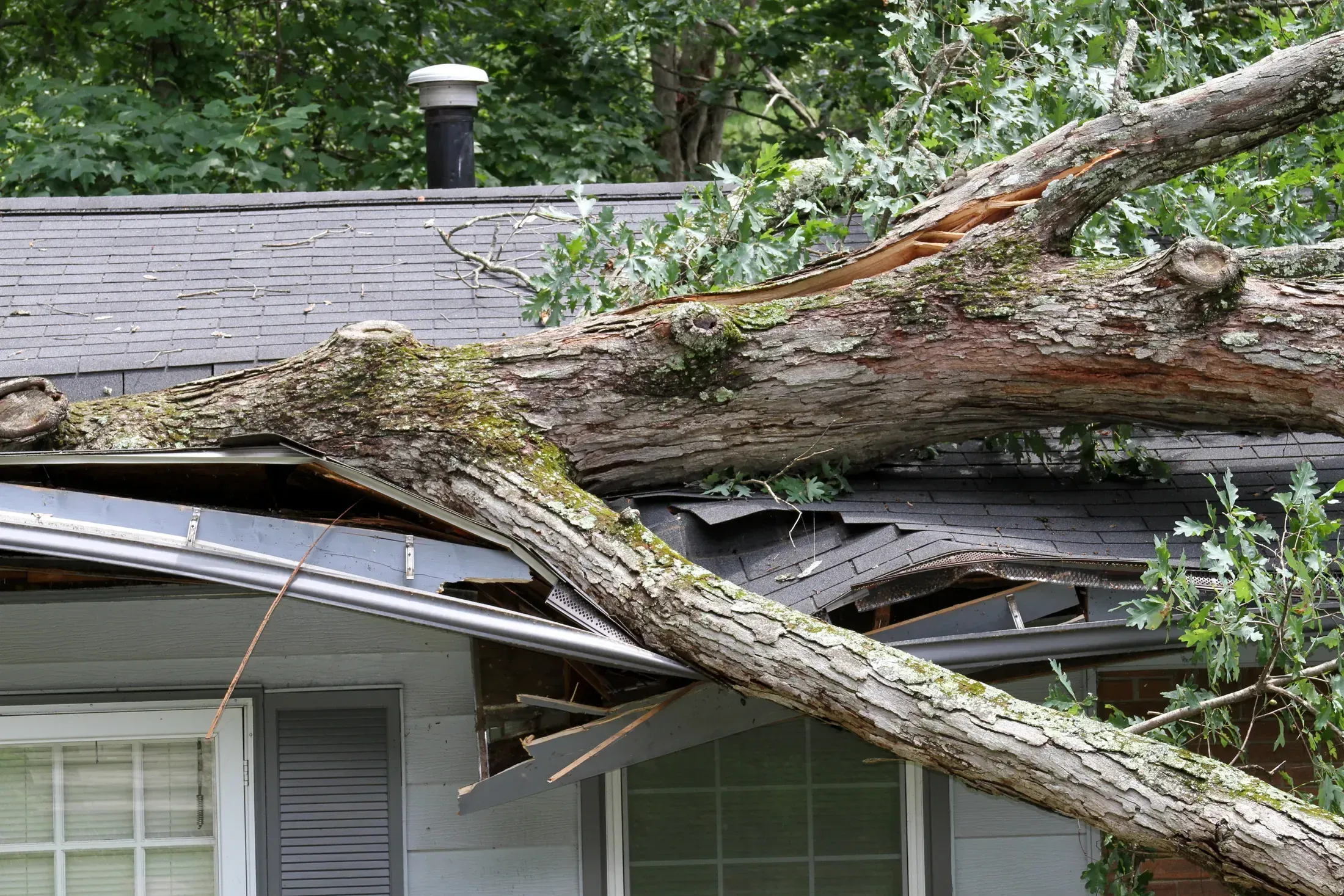
- A tree on the house, garage, or a vehicle someone needs. Weight on a roof shifts as the tree settles, and a hole in the roof lets the next band of rain in.
- A limb hanging over a walkway, driveway, or play area. A broken limb caught in the canopy, sometimes called a hanger, can let go hours or days later with no warning.
- A tree leaning with lifted roots. If the soil on the side away from the lean has cracked or heaved, the root plate is failing and the tree is on its way down. Keep everyone out of the fall zone.
- Anything in contact with a power line. That is a call to Xcel Energy first, not a tree service.
- A tree blocking the only way in or out of the property.
Can usually wait for daylight or a scheduled visit:
- A limb down in an open part of the yard, hitting nothing.
- A tree that has lost part of its canopy but is standing straight with no root movement.
- Bark damage, small broken branches, or a split in a limb that is not over anything.
- A fence flattened by a tree that is now resting on the ground and stable.
Waiting a day on the second list is not just about cost. After a big storm, every crew in the Panhandle is triaging the first list, and the tree in your open back yard is safer where it is than a rushed job at midnight. If you want to know whether a standing tree is likely to go in the next storm, the will-it-fall guide covers the signs, and the is my tree dying or dangerous page covers longer-term warning signs.
Amarillo’s two hail seasons
The Texas Panhandle is unusual among Texas regions in having two hail seasons. The primary one runs March through early May and peaks in April and early May. A smaller secondary season shows up in September and October, with smaller stones and more isolated storms.
The spring storms are the ones that fill tree crews’ phones. They arrive with wind, they arrive when trees have just leafed out and are carrying full weight, and they arrive after a winter of the temperature swings the National Weather Service in Amarillo describes in its climate narrative, with shifts of 50 to 60 degrees inside 12 hours. Wood that has been through that kind of cycling is not at its strongest in April.
Why Siberian elms and cottonwoods take the worst of it
Two species show up in most storm-damage calls around Amarillo, and it is not a coincidence.
Siberian elm is the dominant big tree in older neighborhoods like Wolflin and across much of Potter County. It is brittle, it sheds limbs in ordinary wind, and older trees are commonly hollow where large limbs meet the trunk. In a spring storm, those limbs let go.
Cottonwood is the big tree of Bushland acreage and the older parts of Randall County. It grows fast, gets heavy, and is commonly hollow with age. A mature cottonwood carries an enormous amount of weight on a trunk that may be mostly shell.
Underneath both of them is the same soil. The City of Amarillo’s foundation manual describes most Panhandle homes sitting on slab-on-ground foundations, many on expansive clays, and a shallow caliche hardpan, a chalky calcium-carbonate layer, runs across much of Potter and Randall County. Roots here tend to spread wide rather than deep. A tall, heavy, brittle tree on a wide, shallow root plate is exactly the tree that goes over when a storm hits it broadside. The caliche soil guide goes deeper on that.
What emergency crews actually do, in order
An emergency call is rarely a full removal on the first visit. The sequence usually looks like this:
- Make safe. The crew’s first job is to stop the situation getting worse: cut away hangers over walkways, relieve limbs under tension so nothing springs when it is cut, and stabilize or cut back a leaning tree so it cannot fall further. If a line is involved, nothing happens until the utility has cleared it.
- Remove from the structure. Getting the weight off the roof, garage, or vehicle is the second priority. On a house this is usually done in sections, often with a crane if one can be positioned, because dragging a whole tree off a roof does more damage than the fall did. Once the tree is off, a roofer or the homeowner can tarp the opening.
- Full removal and cleanup, sometimes days later. With the tree on the ground and the property safe, finishing the job, cutting up the trunk, chipping, hauling, and dealing with the stump, is no longer an emergency. After a widespread storm, crews commonly make-safe a dozen properties first and circle back for the cleanup once the urgent list is clear. That is normal, and it is often cheaper, since the second visit is billed at ordinary rates rather than emergency ones.
Ask the provider up front which of these three they are quoting. A “get it off the house tonight” price and a “gone, chipped, and hauled” price are two different numbers.
What emergency tree removal costs in Amarillo
There is no published emergency rate for Amarillo, and this site does not invent one. What can be said honestly:
- The base is the standard tier. Local published removal prices run $400–$2,000+ per tree: small ornamental trees at $400–$600, mid-size trees at $600–$1,100, large trees in an open yard at $1,100–$1,600, and large trees near a structure or power line at $1,600–$2,000+. Those tiers are broken down on the tree removal cost page.
- Expect a premium on top. After-hours, same-day, and crane or rigging work all cost more than the same job scheduled on a quiet Tuesday. How much more is between you and the provider, and it belongs in writing before the crew starts.
- A downed tree can cost less than a standing one. If the storm put the tree flat on open ground and a truck can get to it, the hazardous, skilled part of the job, taking it apart in the air, is already done. Cutting up and hauling a tree on the ground is simpler work, and a fair quote reflects that.
- The extras are still extras. Debris hauling, published locally at $100–$200+ when quoted separately, and stump grinding, at $64–$680 per stump by size, are usually separate lines on a storm job too.
If a provider will not give you a number before starting, or gives a number that changes substantially once the work is done, that is a reason to ask for an itemized invoice and, if needed, a second opinion before paying.
Insurance basics
This is general information, not a reading of your policy. Confirm everything with your insurer.
- Homeowner policies commonly cover tree removal when the tree damages a covered structure, such as the house, an attached garage, or a fence. Coverage often comes with a limit for removal specifically, separate from the structure repair.
- A tree that falls in the yard and hits nothing is often not covered. The policy responds to damage to the property it insures, and an empty patch of lawn is not that.
- A neighbor’s tree on your house is usually your claim, filed with your own insurer, unless there is evidence the neighbor knew the tree was hazardous and ignored it. Your insurer may pursue theirs afterward.
- Call the insurer early. Ask whether they want an adjuster to see the tree before it is moved, and whether emergency make-safe work can proceed in the meantime. Most will say yes to make-safe as long as you have photos.
- Get the provider’s itemized invoice. Removal from the structure, cleanup, hauling, and stump grinding should be separate lines. Insurers pay against specific items, and a single lump-sum number slows everything down.
Whether any of this applies to you depends on your policy’s wording, limits, and deductible. The person to ask is your agent or adjuster.
Storm-chaser red flags
Widespread storms bring crews that follow the weather from town to town. Some are fine. Enough are not that it is worth a checklist:
- Out-of-area plates and no local address. Ask where the business is based and how to reach them next month.
- Cash up front, or a large deposit before work starts. Reputable providers invoice on completion and take a check or card.
- “Your insurance will pay for all of it.” Nobody knows that but your insurer. A crew that says it is either guessing or planning to bill high.
- No insurance certificate. Texas does not license tree services, so the certificate of general liability insurance and workers’ comp is the credential. If they cannot produce one, an injury on your property may become your problem.
- A “city license number.” The City of Amarillo does not issue contractor ID numbers for tree work. A company quoting one is not offering a real credential.
- Pressure to sign now. The tree will still be there in an hour. A fair quote will too.
- Willing to work near a live line. A crew that will cut within reach of an energized Xcel Energy line is taking a risk you do not want on your property. Line clearance is the utility’s job.
After the emergency
Once the tree is off the structure and the property is safe, the rest is a normal removal, with normal pricing and normal questions: whether the stump comes out, where the wood goes, and who repairs the ruts. The tree removal hub walks through that part start to finish.
If you have a standing tree you are now worried about, the quiet stretch between hail seasons is the time to have it looked at. Panhandle Tree Care matches homeowners across Amarillo, Canyon, Bushland, and the Wolflin area with independent local tree services who can assess a damaged tree and put a scope and price in writing. Request a quote, or call (806) 555-0142.
FAQ
Emergency & Storm-Damage Tree Removal in Amarillo: What to Do First: Questions Amarillo Homeowners Ask
What should I do first if a tree falls on my house in Amarillo?
Get everyone out of the rooms under the damage, and out of the house if the roof or a wall is compromised. If any power line is down or touching the tree, stay far away and call Xcel Energy or 911 before calling anyone else. Then photograph the damage from every angle before a tree service or anyone else moves a branch, because your insurer will want to see it as it landed.
How much does emergency tree removal cost in Amarillo?
There is no published emergency rate for Amarillo, so expect a premium over the standard removal tiers of $400–$2,000+ per tree for after-hours, same-day, or crane and rigging work, and get that number in writing before the crew starts. A storm-downed tree already lying on open ground with clear access can actually cost less than a standing removal of the same size, because the dangerous part is already done.
Does homeowners insurance cover tree removal after a storm?
Commonly, yes, when the tree damaged a covered structure such as the house, garage, or fence, but coverage and limits vary by policy. A tree that falls in the yard and hits nothing is often not covered. Call your insurer early, ask what they need, and get an itemized invoice from the provider that separates removal from the structure, cleanup, and any stump work.
Is a tree leaning after a storm an emergency?
It is if the lean is new, the soil on the opposite side has lifted or cracked, or the tree is pointed at a house, driveway, or sidewalk. A tree that has leaned the same way for years and shows no root movement can usually wait for a scheduled look. When in doubt, keep people out from under it and have a provider assess it the same day.
Why do Siberian elms and cottonwoods fail so often in Amarillo storms?
Siberian elm is a brittle species that sheds limbs even in ordinary wind, and cottonwood grows fast, heavy, and commonly hollow with age. Add Amarillo's shallow caliche layer, which tends to push roots wide rather than deep, and the biggest, oldest trees in Wolflin and on Bushland acreage are the ones with the most weight up top and the least anchor underneath. Spring hail storms, with their wind, hit them hardest.
How do I avoid storm-chaser tree crews after a big storm?
Be cautious with any crew that knocks on the door unprompted, especially with out-of-area plates, a cash-up-front ask, or a promise that your insurance will pay for everything. Ask for a certificate of general liability insurance and workers' comp, a written scope, and a local address. Texas does not license tree services, so the insurance certificate is the document that matters.
Keep reading
Related Amarillo tree guides
Ready for a real quote from a local Amarillo tree service?
Tell us what your tree is doing and we’ll match you with an independent local provider serving Amarillo, Canyon, and Bushland. No obligation to hire.