Amarillo Service Guide
Stump Grinding in Amarillo, TX: How It Works & What's Left Behind
Published September 8, 2026 · Last reviewed · Amarillo, Canyon & Bushland, TX
The short answer
Stump grinding uses a machine with a spinning carbide-toothed wheel to chew a tree stump down below grade, leaving the roots to rot in place. As of September 2026, it runs $64–$680 per stump in Amarillo, TX, depending on the size of the tree that stood there.
Panhandle Tree Care · (806) 555-0142 · matching Amarillo-area homeowners with independent local tree service providers.
A stump grinder is the simplest way to make a stump disappear without digging a hole the size of a hot tub. The machine grinds the wood into chips a little at a time, working down until the stump is below the soil line and the roots are left to rot on their own schedule. This page walks through what that looks like in an Amarillo yard, what you are left with, and what to do about it. For the four price tiers and what moves the number, see the stump grinding cost page.
How a grind works
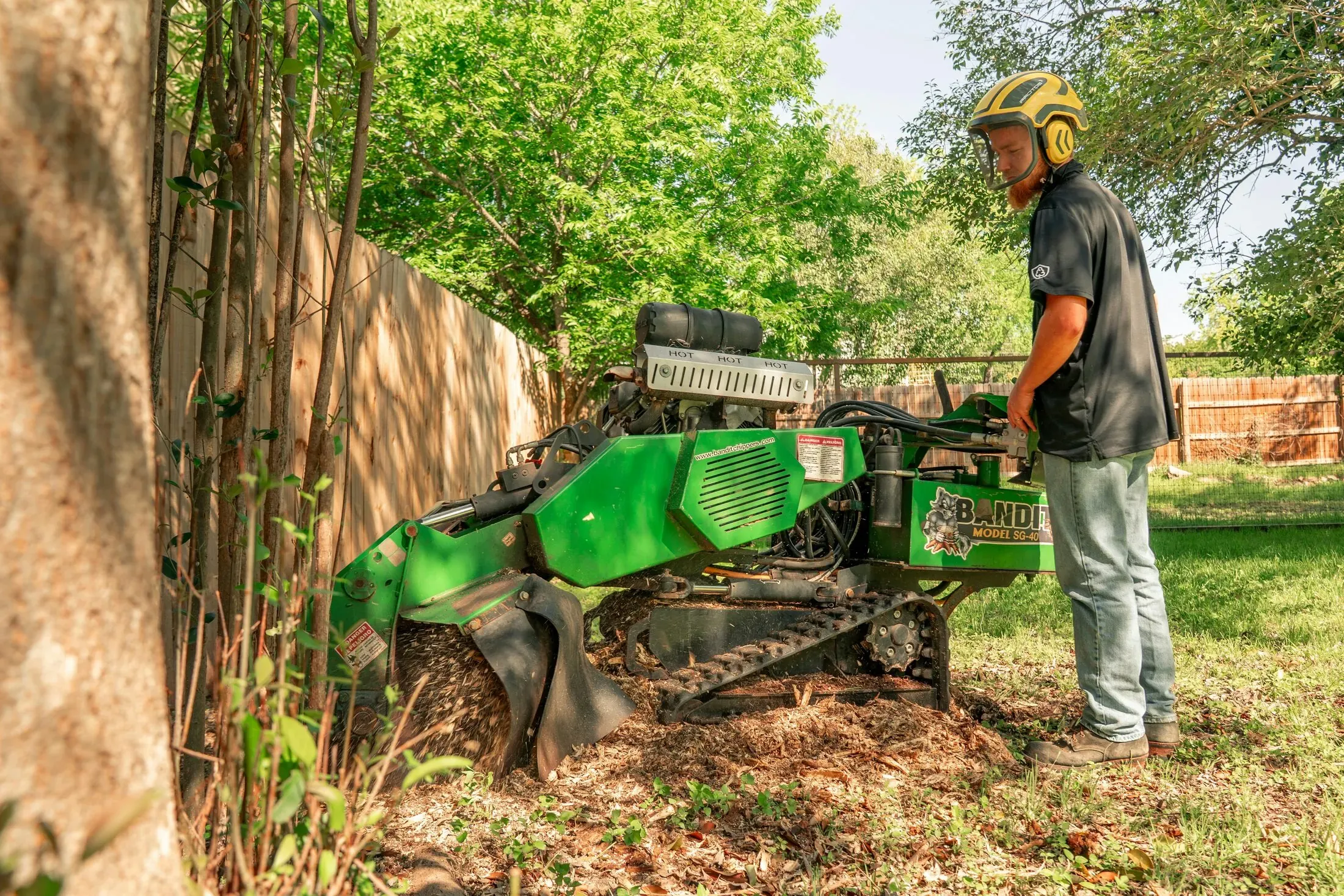
The machine itself ranges from a walk-behind unit narrow enough to fit through a standard side gate up to a tow-behind or tracked grinder that needs a wide opening. All of them work the same way. A heavy steel wheel studded with carbide teeth spins at high speed, and the operator sweeps it side to side across the top of the stump, lowering it a little each pass.
The cutting wheel turns the stump and the top of the root flare into a mix of wood chips and soil that piles up around and behind the machine. On a large stump that chip mound is bigger than the stump was, because chipped wood takes up far more room than solid wood. The operator keeps grinding until the wood is below grade and the flare is flattened, then rakes the chips back into the hole or piles them for you to deal with.
What you do not see is any digging. The lateral roots stay in the ground. That is the whole trade-off of grinding compared to excavation, and for most lawns it is the right one.
Grinding vs. stump removal vs. leaving it
There are three ways to handle a stump, and they suit different situations.
Grinding takes the visible stump below the soil line and leaves the roots. It is the least expensive option, the least disruptive to the surrounding lawn, and the standard choice when the spot is going back to grass or a bed.
Full stump removal digs out the entire root ball with an excavator or backhoe. It costs more, leaves a large hole, and tears up a wider circle of yard. It is usually only worth it when you plan to build on the spot, pour concrete across it, or plant a new tree in the exact same hole where roots would be in the way. Ask the provider to price it separately if you think you need it.
Leaving it costs nothing today. The stump becomes a mowing obstacle, a tripping hazard, and a food source for termites and ants, and elm and cottonwood stumps will sprout for years. On acreage in Bushland where nobody mows near it, that can be fine. In a Wolflin front yard, it usually is not.
Our tree removal page covers the decision that comes before all of this: whether the tree needs to come down at all.
Timing: same visit or later
If a tree service is already removing the tree, the cheapest time to grind the stump is the same visit. The crew is on site, the equipment is unloaded, and the grind is added to a job that is already paid for. Ask for the removal quote with and without the grind so the difference is plain.
Not every removal crew owns a grinder. Some will refer a stump-only operator, and that second visit is priced on its own. There is no harm in waiting, either. A stump can sit for a season or a year and still grind fine, and some homeowners spread the cost by taking the tree down in one season and grinding the stump in the next. The only real cost of waiting is the sprouting, which starts soon after an elm or cottonwood is cut.
Stumps from trees that came down in a storm can be ground anytime after the trunk is cleared. If the tree was uprooted rather than snapped, the root plate is already half out of the ground and the job looks more like removal than grinding. See the emergency and storm damage page for how that work is handled.
Root sprouts on Siberian elm and cottonwood
The two big trees of older Amarillo neighborhoods, Siberian elm and cottonwood, are both aggressive sprouters. When the trunk is cut, the root system still holds a reserve of energy and responds by sending up shoots wherever a root is close to the surface. Grinding removes the stump but does not stop the sprouts, because the roots that make them are still there.
What works:
- Mow or cut them consistently. Every sprout you remove is energy the roots spent for nothing. Kept up for a couple of seasons, this exhausts the reserve.
- Cut at the soil line, not above it. A sprout cut high just branches.
- Ask about stump treatment before grinding. Some providers apply a herbicide to the fresh cut surface at removal time to reduce sprouting. Whether that is appropriate depends on what else is planted nearby, so ask the provider rather than doing it yourself.
- Do not fertilize or overwater the area while you are trying to starve the roots out.
Hackberry sprouts occasionally too, but rarely with the persistence of elm or cottonwood.
Filling and reseeding the hole
Once the grinder leaves, you have a mound of chips and, under it, a shallow crater. Here is the sequence that gives you a lawn instead of a permanent dip.
- Rake the chips out. Chips mixed with soil will rot down and the spot will sink as they do. Spread them as mulch elsewhere, use them to fill a low spot you do not care about, or have the provider haul them.
- Backfill with topsoil. Fill the crater a little higher than grade, because it will settle.
- Water and wait. A few soakings will settle the soil and show you how much more it needs.
- Top off and seed or sod. Once the fill has stopped sinking, bring it to grade and plant. Expect to top it off once more the following season.
Because caliche sits shallow across much of Potter and Randall County, the grinder often stops above hardpan and the crater is not as deep as it would be in softer soil. That means less fill, which is one of the few things caliche makes easier. Our caliche guide explains why the same hardpan shapes how local trees root in the first place.
If you intend to plant a replacement tree, do not put it in the ground stump’s hole. The decaying roots and chips tie up nitrogen and leave the soil unstable for years. Plant a few feet away.
Call 811 before grinding
A stump grinder cuts below grade, and it does not stop for a gas line. Call 811, the national call-before-you-dig line, a few business days ahead of the grind so buried utilities can be marked. The service is free. Mark your own sprinkler lines, valve boxes, and low-voltage wiring with flags as well, because 811 marks public utilities, not private irrigation.
If the stump sits near an overhead line, that is a different concern. Xcel Energy handles line clearance in Amarillo, and a private crew should not work within reach of an energized line.
Who does it
Stump grinding in Amarillo is handled by two kinds of businesses. Many full-service tree removal crews own a grinder and fold the grind into the removal quote. Alongside them are stump-only operators who do nothing but grinding, often with a small machine that fits through gates the big rigs cannot. Either can do the job well, and a stump-only operator is often the more economical call when there is no tree to remove.
Texas does not license tree services, so there is no state credential to check for either type. Ask for a certificate of general liability insurance and workers’ comp before anyone unloads a machine in your yard. If you also want advice on the trees you are keeping, ask whether anyone on staff holds the voluntary ISA Certified Arborist credential. The best tree service companies page profiles established local providers and notes which ones list stump grinding among their services.
Across the whole Amarillo market, expect $64–$680 per stump, with the size of the tree that stood there setting which end of that span you land on. Get the number in writing, with the diameter and depth it is based on, before the grinder arrives. When you are ready, tell us about your stump and we will match you with an independent provider who serves Amarillo, Canyon, or Bushland.
FAQ
Stump Grinding in Amarillo, TX: How It Works & What's Left Behind: Questions Amarillo Homeowners Ask
How long does stump grinding take?
A small stump in soft soil can be ground in a matter of minutes once the machine is set up, while a large flared elm or cottonwood stump over hard ground can take an hour or more. The provider's time is driven by the diameter at ground level, the depth of the grind, and whether the teeth are hitting caliche or rock. Multiple stumps are usually done in one visit.
How deep does a stump grinder go?
A grinder goes as deep as the ground allows, which in Amarillo often means it stops where the caliche hardpan begins. That is deep enough to plant grass over the spot in most yards. If you want to plant a replacement tree in the same hole, tell the provider, because that may call for full root-ball removal instead of grinding.
Will the tree grow back after grinding?
The stump itself will not regrow, but Siberian elm and cottonwood roots left in the ground commonly send up sprouts for several seasons afterward. Mowing them consistently or cutting them at the soil line exhausts the root reserves over time. Ask the provider about treating the cut surface before grinding if sprouting worries you.
Do I have to call 811 before stump grinding?
Yes, call 811 a few business days before any grinding so buried gas, electric, and communication lines can be marked. A grinder cuts below grade, and lines are often shallower than people expect near the house. The marking is free, and most providers will not start without it.
Who grinds stumps in Amarillo?
Many Amarillo tree removal crews own a grinder and will add the grind to a removal, and there are also stump-only operators who do nothing else. Either can do the job well. Ask for a certificate of general liability insurance either way, since Texas does not license tree services and there is no state credential to check.
Keep reading
Related Amarillo tree guides
Ready for a real quote from a local Amarillo tree service?
Tell us what your tree is doing and we’ll match you with an independent local provider serving Amarillo, Canyon, and Bushland. No obligation to hire.