Amarillo Cost & Decision Guide
Tree Removal Cost in Amarillo, TX: 2026 Price Guide by Tree Size
Published September 8, 2026 · Last reviewed · Amarillo, Canyon & Bushland, TX
The short answer
As of September 2026, tree removal in Amarillo, TX runs $400–$2,000+ per tree. A small ornamental tree is typically $400–$600, while a large tree next to a house, garage, or power line is $1,600–$2,000+, with stump grinding and debris hauling often quoted on top.
Panhandle Tree Care · (806) 555-0142 · matching Amarillo-area homeowners with independent local tree service providers.
The gap between a $400 tree and a $2,000 tree in Amarillo is not really about the tree. It is about how much labor and equipment it takes to get the wood down safely without hitting anything. Two trees of the same height can be quoted a thousand dollars apart because one stands alone in a Bushland pasture and the other leans over a garage roof in Wolflin.
This guide walks through what moves the price, what local companies actually publish, and how to read a quote so you know what you are paying for.
What moves the price of tree removal in Amarillo
Tree size
Size is the first thing any provider looks at. Height, trunk diameter, and canopy spread all add cutting time and add weight that has to be handled. Local price tables cluster removals into rough size tiers, and those tiers explain most of the spread you will see in quotes.
One Amarillo company publishes an example that is useful as a mental anchor: a roughly 20-ft tree in an open yard at $400–$800. That is the kind of tree a crew can fell in one piece and cut up on the ground.
Proximity: felling versus rigging
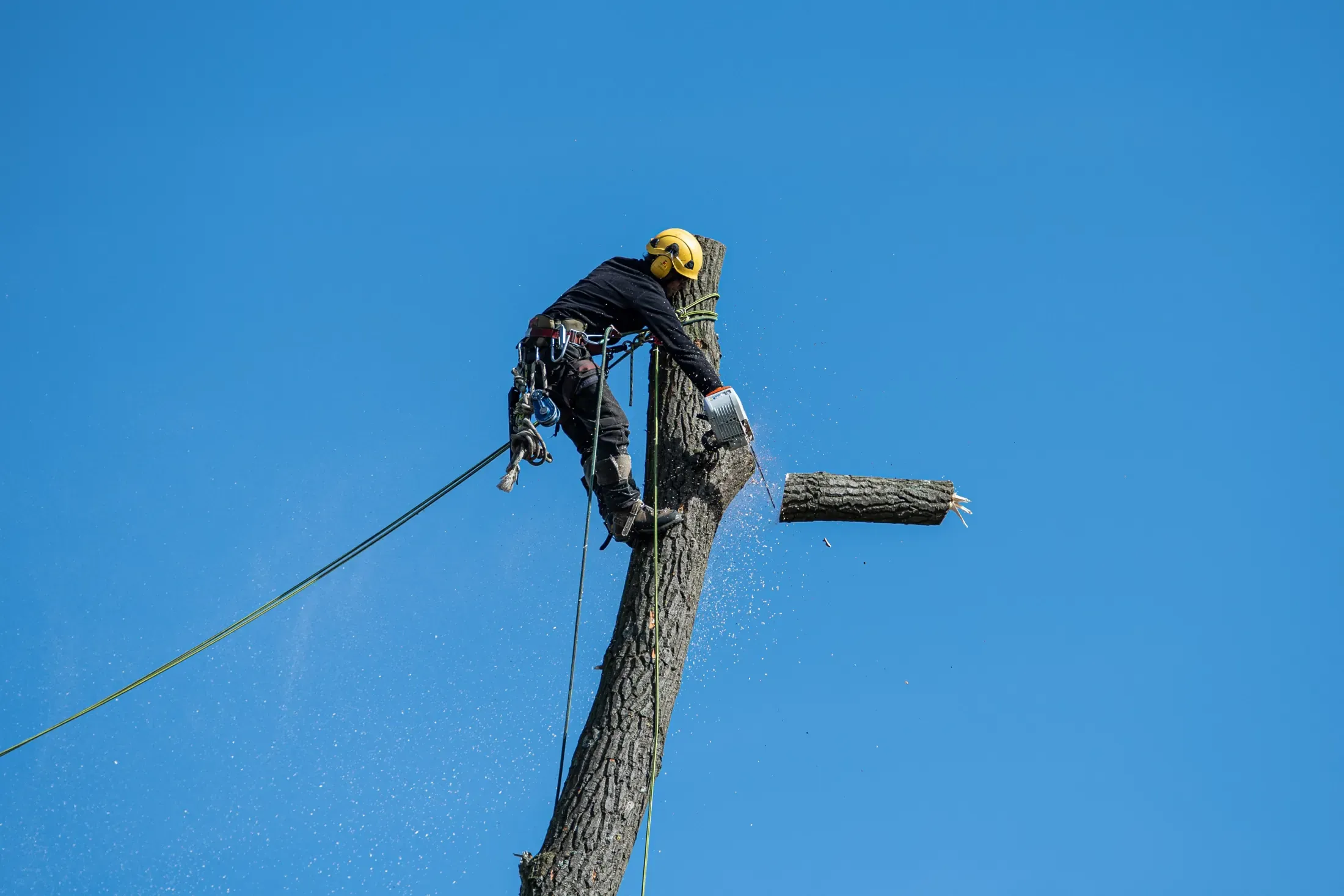
The single biggest jump in price happens when a tree cannot simply be cut at the base and dropped. If there is a house, garage, fence, shed, pool, or neighbor’s property under the canopy, the crew has to climb and take the tree apart in sections, lowering each piece with ropes. That is rigging, and it turns a two-hour job into a full-day job.
A tree within reach of a power line is a separate category again. Xcel Energy (Southwestern Public Service) handles clearance near its own lines, and a private crew should not be working within reach of an energized line. If a tree is tangled in a service drop, expect the provider to coordinate with the utility first, which affects both the timeline and the cost.
Species and wood condition
Amarillo’s yard trees are commonly Siberian elm, cottonwood, hackberry, honey locust, Austrian pine, and mesquite on the outskirts. Two of those change the math:
- Siberian elm is brittle. Limbs can snap unexpectedly under a climber’s weight or under a rigging load, so crews tend to work these trees in smaller, more careful sections. That is more time.
- Cottonwood is heavy, fast-growing, and commonly hollow as it ages, particularly on older Bushland acreage where it was planted for shade and windbreaks. A hollow trunk is unpredictable to cut, and the sheer mass of a mature cottonwood means more loads to haul.
Hackberry and honey locust are usually more predictable. Austrian pine is sappy and messy but generally straightforward. A dead tree of any species is riskier to climb than a live one, which can move a job from “climb and section” to “bucket truck or crane.”
Access
Can a chipper truck and a bucket truck get near the tree? A front-yard tree on a Puckett or Sleepy Hollow street is easy. A backyard tree behind a six-foot privacy fence with a narrow gate means every piece gets carried out by hand, and the crew may need to lay plywood to keep a bobcat from rutting the lawn. Alley access helps in older Potter County neighborhoods; it is often the deciding factor in whether a crane can be used at all.
Debris hauling
Some providers fold cleanup into the removal price. Others quote it separately. One local company’s blog puts debris hauling at $100–$200+ when it is a separate line. If you want the trunk wood left for firewood, or the chips left for mulch, say so up front; it can reduce the haul cost, though it will not always reduce the total.
Stump grinding as an add-on
Removal quotes in Amarillo commonly stop at ground level. The stump is a separate job with a separate machine. Cost-aggregator figures for Amarillo stump grinding, tiered by the size of the tree the stump came from, run:
- Small tree (under 25 ft): $64–$128
- Medium tree (25–50 ft): $128–$255
- Large tree (50–75 ft): $255–$425
- Extra-large tree (75 ft+): $425–$680
Those are aggregator figures rather than a panel of local quotes, and the aggregator credits Amarillo’s below-national stump prices to the smaller, wind-adapted species that dominate local yards. Treat them as a sanity check, not a promise. The full picture is on the stump grinding cost page.
Season and storm timing
The Panhandle has two hail seasons: a primary one from March through early May, peaking in April and early May, and a smaller secondary one in September and October with smaller stones and isolated storms. After a big spring storm, every crew in town is booked, and same-day or after-hours work carries a premium over the standard tiers. No local company publishes that premium, so get it in writing. Scheduling a planned removal in a quiet month, and being flexible on the date, is the easiest way to land at the lower end of a quote.
Tree removal prices in Amarillo by tier
| Tree size and situation | Amarillo price (per tree) |
|---|---|
| Small ornamental tree | $400–$600 |
| Mid-size tree | $600–$1,100 |
| Large tree, open yard | $1,100–$1,600 |
| Large tree near a structure or power line | $1,600–$2,000+ |
| Small standing tree under 30 ft (ProMatcher, Amarillo) | about $380 (range $340–$421) |
| National benchmark (HomeGuide, 2026) | average about $850; typical $400–$1,200; up to $2,500+ for extra-large trees |
A few notes on reading the table:
- The four Amarillo tiers come from local published price tables. The whole-market span they describe is $400–$2,000+ per tree.
- The ProMatcher row is a narrow estimate for a small standing tree and lands inside the local “small ornamental” tier, which is a good sign the local tables are honest.
- The HomeGuide row is national. Amarillo’s typical trees are smaller than the national mix, which is part of why local tiers top out lower than the national ceiling.
- Every row assumes normal access. Add debris hauling ($100–$200+ if separate) and stump grinding ($64–$680 by size) on top where they apply.
Why aggregator ranges are so wide
If you have searched this question already, you have probably seen a figure like $128–$4,250 for Amarillo tree removal. That comes from a cost aggregator, and it is not wrong so much as unhelpful. A span that wide is trying to cover a single small trunk that a crew drops in twenty minutes and a multi-day crane removal of a hollow cottonwood over a house, in one number.
Aggregators also blend user-submitted job costs, contractor bids, and modeled estimates from other markets. Local companies that put their own price tables on their websites have to stand behind those numbers when the phone rings, which is why their ranges are tighter and, for most homeowners, more useful.
The right way to use an aggregator range is as a ceiling check. If a quote for an ordinary mid-size tree comes in near the top of that span, something is off.
How we source these numbers
The figures on this page come from three places: price tables and blog examples published by Amarillo tree service companies, Amarillo-labeled pages on national cost aggregators (ProMatcher and ArborHub), and the 2026 national HomeGuide benchmark for context. We do not perform tree work and we do not set prices; we compile what is published and re-check it. This page was reviewed in September 2026. The full method, including what we exclude and why, is on the methodology section of our About page.
How to read a tree removal quote
A good quote is boring. It lists exactly what will happen and what it costs. When you get one, look for these items spelled out:
- Which tree or trees. By location or a photo, so there is no confusion on the day.
- Method. Felled whole, climbed and sectioned, bucket truck, or crane. Rigging is the expensive part, and it should be visible in the number.
- Stump. Ground, and to what depth, or left in place. Grinding is usually a separate line.
- Debris. Hauled off, chipped and left, or trunk wood stacked for you. If hauling is separate, it should say so.
- Cleanup. Raking, blowing, and whether ruts or lawn damage are the provider’s responsibility.
- Date and duration. When the crew arrives and roughly how long the job takes.
- Total price and payment terms. Per tree or per job, deposit if any, and when the balance is due.
- Insurance. The certificate of general liability insurance and workers’ comp should be available on request, ideally sent from the insurer.
If a quote is a single number on a business card, ask for the itemized version before comparing it against anyone else’s.
Red flags on a tree removal quote
- A “city license number.” The City of Amarillo does not issue contractor ID numbers for tree work, and Texas has no state license for tree services. A company that claims either is either confused or hoping you are.
- Cash only, or a large cash deposit up front. Reputable providers take a check or card and invoice on completion.
- No insurance certificate. If the provider cannot produce a certificate of general liability insurance and workers’ comp, you may be carrying the risk of an injury on your property.
- Topping offered as the cheaper option. Cutting the top out of a tree to avoid removing it creates weak, fast-growing regrowth and a bigger problem in a few years. An ISA Certified Arborist, a voluntary credential worth asking about, will generally steer you away from it.
- Working near a power line without involving the utility. A crew that is willing to work within reach of an energized Xcel Energy line is taking a risk you do not want on your property.
- Pressure to decide today. Storm season brings out-of-town crews that need to fill the truck. A fair quote will still be fair tomorrow.
When removal is not the answer
Some trees that look like removal candidates are trimming candidates. A Siberian elm with a couple of dead limbs over the driveway may need a $250–$800 trim, not a $1,600–$2,000+ removal. If you are not sure which one you are looking at, the tree removal versus trimming guide walks through the difference, and the is my tree dying or dangerous page covers the signs that actually mean a tree has to come down.
Getting a number for your tree
The only way to get a real price is to have a provider stand under the tree. Panhandle Tree Care matches homeowners in Amarillo, Canyon, Bushland, and the Wolflin area with independent local tree services who will look at the job and put a scope and a price in writing. Request a quote, or read about what a removal involves start to finish before you do.
FAQ
Tree Removal Cost in Amarillo, TX: 2026 Price Guide by Tree Size: Questions Amarillo Homeowners Ask
How much does it cost to remove a tree in Amarillo, TX?
As of September 2026, tree removal in Amarillo runs $400–$2,000+ per tree, depending mostly on size and how close the tree is to a structure. Small ornamental trees sit at the low end ($400–$600), mid-size trees run $600–$1,100, and large trees in an open yard run $1,100–$1,600. Once a large tree is close to a house, garage, fence, or power line, expect $1,600–$2,000+.
Is stump grinding included in the tree removal price?
Usually not; most Amarillo tree services quote stump grinding as a separate line item. Cost-aggregator figures for Amarillo put stump grinding at $64–$680 per stump depending on the size of the tree it came from, with small trees under 25 ft at $64–$128 and extra-large trees over 75 ft at $425–$680. Ask the provider to state clearly whether the stump is included, ground, or left in place.
Why are online tree removal estimates for Amarillo so different from each other?
National cost aggregators pull from a mix of sources and show very wide spans, sometimes $128–$4,250 for Amarillo alone. Local companies that publish their own price tables cluster much tighter, at $400–$2,000+ per tree. The wide aggregator figures usually include everything from a single small trunk to a multi-day crane job, so they are not very useful for guessing what your specific tree will cost.
Does the type of tree change the removal price in Amarillo?
Yes, species matters, but mostly through size, weight, and how safely the wood handles. Siberian elms, common in older neighborhoods like Wolflin, are brittle and tend to be sectioned carefully rather than dropped in big pieces. Cottonwoods are heavy and often hollow with age, which adds rigging time. The species itself rarely gets a separate charge; the labor it creates does.
Does Amarillo require a permit to remove a tree on my property?
That question is unresolved, and this site does not state an answer either way. The City of Amarillo Building Safety Division's public exemption list does not mention tree work, so the safe move is to call Building Safety at 806-378-3041 (808 S Buchanan St, Suite 104) before scheduling a removal inside city limits. Canyon addresses go through the City of Canyon Planning and Development office at 806-655-5014, and Bushland is unincorporated Potter County with no city permit office.
What should I check before hiring a tree removal company in Amarillo?
Ask for a certificate of general liability insurance and proof of workers' compensation coverage, since Texas does not license tree services. Then get the scope in writing: which tree, whether the stump is ground, whether debris and wood are hauled, the date, and the total price. Two or three written quotes will tell you quickly whether one number is out of line.
Keep reading
Related Amarillo tree guides
Ready for a real quote from a local Amarillo tree service?
Tell us what your tree is doing and we’ll match you with an independent local provider serving Amarillo, Canyon, and Bushland. No obligation to hire.