Amarillo Service Guide
Tree Removal in Amarillo, TX: What's Involved, Start to Finish
Published September 8, 2026 · Last reviewed · Amarillo, Canyon & Bushland, TX
The short answer
As of September 2026, tree removal in Amarillo, TX typically means a crew either fells the tree whole in an open yard or climbs it and lowers it down in sections when a house, fence, or power line is in the way, then chips the limbs and hauls or stacks the wood. Local published prices run $400–$2,000+ per tree, with the stump usually quoted separately.
Panhandle Tree Care · (806) 555-0142 · matching Amarillo-area homeowners with independent local tree service providers.
Most people only remove a tree once or twice in the time they own a house, so it is worth knowing what the day actually looks like before a crew shows up with a chipper. This page covers when removal is the right call, how the work is done, what is different about the trees that grow in Amarillo, and what to expect once the truck pulls up.
When removal is the right call, and when trimming is
Removal is permanent, and a mature shade tree in this climate took decades to grow. That makes it worth being sure. A tree usually needs to come out when:
- It is dead, or most of the canopy failed to leaf out this year.
- The trunk is split, or there is a large cavity or hollow through much of it.
- It is leaning more than it used to, and the soil on the opposite side is lifting.
- Large limbs are dropping without a storm to explain it.
- It is growing into the foundation, a sewer line, or the service drop from the power pole, and pruning cannot resolve the conflict.
- It is a fast-growing species planted too close to the house and there is no version of the future where it fits.
A tree with a few dead limbs, a crowded canopy, branches rubbing the roof, or one bad limb over the driveway is usually a trimming candidate. Trimming a tree in Amarillo commonly runs $100–$1,200 per tree, with most jobs in the $250–$800 range, so it is worth ruling out first. The is my tree dying or dangerous page covers the specific signs, and the removal versus trimming guide helps you decide which one you are looking at.
If you are not sure, ask the provider to tell you what a trim would cost alongside the removal quote. A good tree service will give you both.
How a tree removal is done
Felling
In an open yard with nothing under the canopy, the simplest method is to cut a notch and a back cut at the base and drop the tree whole in a chosen direction. It is fast, and it is why a roughly 20-ft tree in an open Amarillo yard is published locally at $400–$800. Felling is only an option when there is a clear landing zone as long as the tree is tall, and when the tree is sound enough to fall predictably.
Sectioning and rigging
When there is a house, garage, fence, shed, pool, or neighbor’s yard under the canopy, the tree comes down in pieces. A climber (or a bucket truck operator, if there is access) starts at the top, cuts limbs one at a time, and either lets them fall into a clear area or lowers them on ropes through a rigging system anchored in the tree. The trunk comes down last, in rounds short enough to control.
This is where most of the cost lives. A large tree near a structure runs $1,600–$2,000+ locally, compared with $1,100–$1,600 for the same tree in an open yard, and the difference is almost entirely rigging time.
Crane jobs
For a big tree over a house, or a dead tree that is not safe to climb, a crane can lift entire sections straight up and set them in the street or driveway. It is faster and often safer, but it needs somewhere to park the crane, which is a real constraint on narrower streets. In older Potter County neighborhoods, alley access often decides whether a crane is possible at all.
Cleanup and what is left
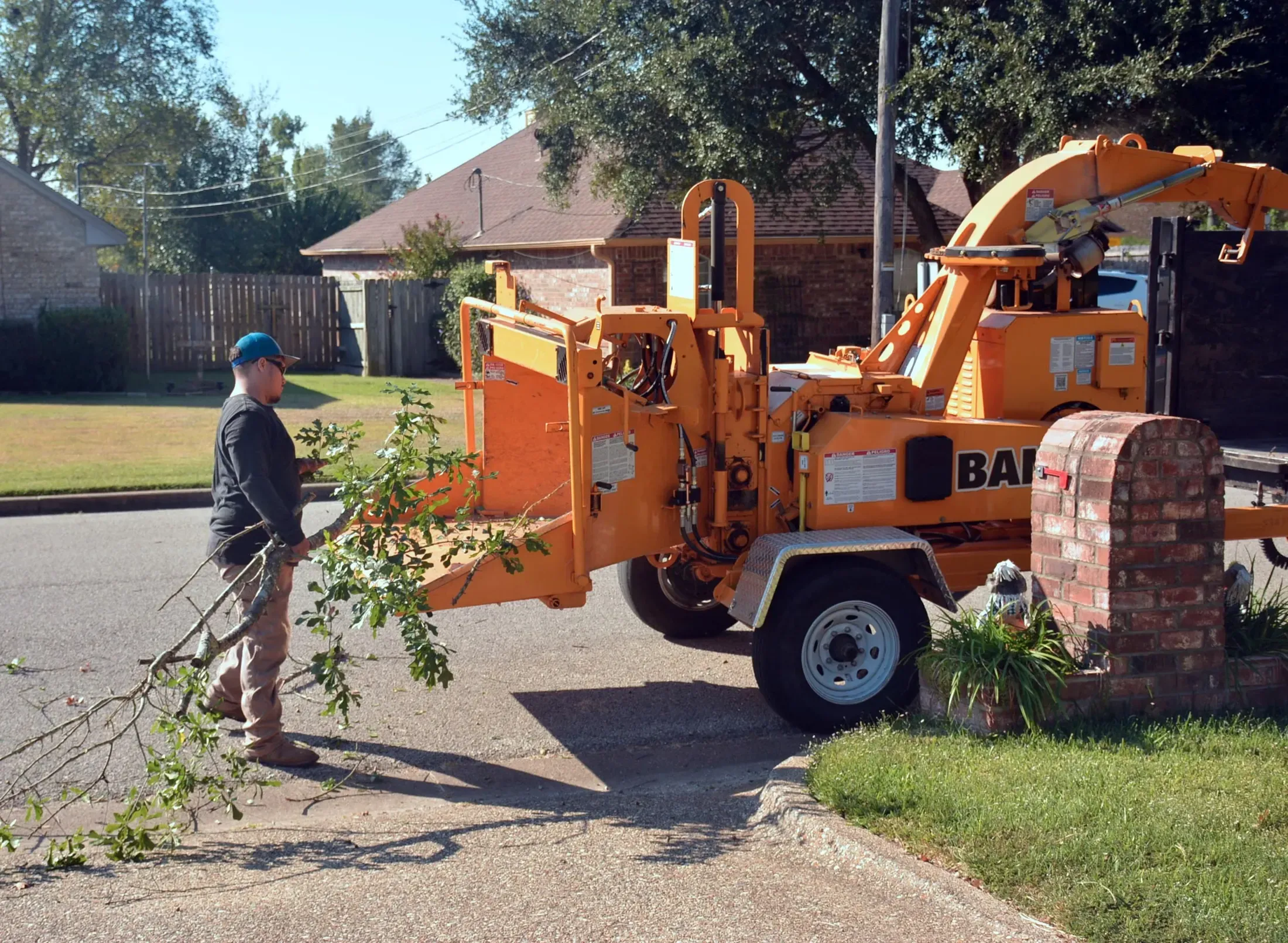
Once the tree is down, limbs go through a chipper, and the trunk is cut into rounds. A standard removal ends with the yard raked and blown. What remains depends on the quote:
- The stump. Usually cut low and left unless grinding was quoted. See the stump grinding hub for what that adds.
- Ruts. Heavy equipment on a wet lawn leaves tracks. Ask whether the crew uses plywood or mats, and who is responsible for repair.
- Chips and wood. Hauled off, left as mulch, or stacked for firewood. Debris hauling is sometimes a separate line, published locally at $100–$200+.
Removing specific Amarillo trees
Amarillo’s yards are commonly planted with a handful of species, and each one behaves differently once a saw is in it.
Siberian elm. The big tree of older neighborhoods, and the reason Wolflin looks the way it does. It is brittle, sheds limbs on its own, and is commonly hollow at the crotches. Crews tend to take Siberian elms down in smaller sections than the size alone would suggest, because a limb that looks solid can let go under load. That caution is time, and it shows up in the quote.
Cottonwood. Fast, water-hungry, and heavy. Commonly planted on Bushland acreage as shade and windbreak, and commonly hollow with age. The mass of a mature cottonwood means more cuts, more rigging, and more truckloads. A hollow trunk also makes felling unpredictable, which pushes crews toward sectioning even in open ground.
Hackberry. Generally straightforward. Sound wood, predictable, moderate weight. A hackberry in an open yard is about as simple as a removal gets at its size.
Austrian pine. Sappy, dense, and messy, but structurally honest. The main cost driver is the volume of limbs to chip. Dead Austrian pines are stiffer and drop needles everywhere, but they are not unusually hazardous to work.
Mesquite. Found on the fringes of the service area and on rural lots. Small, tough, and thorny, with wood that dulls chains. Mesquite removal is less about height and more about the root system, which is why the stump question matters more here than with most trees.
Honey locust rounds out the common list. Thornless cultivars are easy to work; the wild thorned form is an unpleasant climb and crews price it accordingly.
Related work: lot clearing, brush, and hazard trees
Tree removal is one tree at a time. Several Amarillo providers also offer:
- Lot and brush clearing for new construction, acreage, and overgrown fence lines. This is scoped by the area and density rather than per tree.
- Hazard-tree removal, which is the term for a tree that is already failing: a split trunk, a lean with lifted roots, or a dead tree over a target. It is often priced higher than a routine removal of the same size because the tree cannot be climbed normally.
We have not compiled published prices for either, so treat them as quote-on-site work and ask for the scope in writing. If you are dealing with a tree that has already come down or is actively failing, the emergency and storm-damage page covers what to do first.
The permit question
Whether Amarillo requires a permit to remove a tree on private residential property is not something this site can tell you, because the answer is not published. The City of Amarillo Building Safety Division’s public exemption list does not mention tree work in either direction.
The reliable move is to call and ask before you schedule:
- Inside Amarillo city limits: Building Safety Division, 806-378-3041, 808 S Buchanan St, Suite 104, Monday through Friday, 8 to 5.
- Canyon: City of Canyon Planning and Development, 806-655-5014.
- Bushland: unincorporated Potter County, so there is no city permit office, and Texas counties have no general residential permit program.
Trees near utility lines are different. Xcel Energy (Southwestern Public Service) handles clearance around its own lines, and a private crew should not work within reach of an energized line. The permit guide has the longer version.
Storm timing
The Texas Panhandle has two hail seasons. The primary one runs March through early May and peaks in April and early May; a smaller secondary season shows up in September and October with smaller stones and isolated storms. That pattern is unusual for Texas, and it shapes the removal calendar.
After a spring storm, crews are booked for days, and same-day or after-hours work carries a premium that no local company publishes. If a tree has been on your list, the quiet stretches between seasons are when a planned removal is easiest to schedule and most likely to land at the lower end of the range.
What to expect on the day
- A walkthrough. The lead climber or foreman will confirm which tree, the drop zone, where the truck and chipper park, and anything you want protected.
- Setup. Cones, chipper positioned, rigging lines set, sometimes plywood laid on the lawn.
- The cut. Anywhere from a couple of hours for a small open-yard tree to a full day for a large sectioned removal. Expect noise; the chipper is the loudest part.
- Cleanup. Limbs chipped, trunk cut into rounds, yard raked and blown. Wood hauled or stacked per the quote.
- The stump. Cut low. Grinding is typically a separate visit unless it was scheduled together.
- Payment. Per the written quote. If anything changed on the day, it should have been discussed before it happened, not discovered on the invoice.
Getting a quote
Prices for all of this, by tree size and situation, are on the tree removal cost page. For a number on your specific tree, Panhandle Tree Care matches homeowners across Amarillo, Canyon, Bushland, and the Wolflin area with independent local tree services who will look at the job in person. Request a quote or check the service area first.
FAQ
Tree Removal in Amarillo, TX: What's Involved, Start to Finish: Questions Amarillo Homeowners Ask
How do I know if my tree needs to be removed or just trimmed?
A tree usually needs to come out when it is dead, structurally split, leaning with lifted roots, hollow through much of the trunk, or growing into a house or line where pruning cannot fix the conflict. A tree with a few dead limbs, a crowded canopy, or branches touching the roof is usually a trimming job. The diagnostic page on this site walks through the signs that separate the two.
How long does tree removal take in Amarillo?
Most residential removals are a single day, and small open-yard trees can be done in a couple of hours. A large Siberian elm or cottonwood over a house that has to be sectioned piece by piece, or a job that needs a crane, can run a full day or spill into a second. Stump grinding is often scheduled as a separate visit.
Do I need a permit to remove a tree in Amarillo?
That question is unresolved, and this site does not state an answer either way. The City of Amarillo Building Safety Division's public exemption list does not mention tree work, so call Building Safety at 806-378-3041 (808 S Buchanan St, Suite 104) before scheduling a removal inside city limits. Canyon addresses should call City of Canyon Planning and Development at 806-655-5014; Bushland is unincorporated Potter County with no city permit office.
Will the tree service remove the stump too?
Not by default; most Amarillo providers cut the tree to a low stump and quote grinding separately. If you want the stump gone, ask for it as a line item with a grinding depth, and confirm whether the chips are hauled or left to settle. The stump grinding hub covers what that involves.
What happens to the wood and branches after a removal?
Limbs are usually run through a chipper on site, and the trunk is cut into rounds. Whether all of that is hauled away, or the chips are left as mulch and the rounds stacked for firewood, depends on what you ask for and what the quote says. Hauling is sometimes a separate line, so confirm it in writing.
Keep reading
Related Amarillo tree guides
Ready for a real quote from a local Amarillo tree service?
Tell us what your tree is doing and we’ll match you with an independent local provider serving Amarillo, Canyon, and Bushland. No obligation to hire.