Amarillo Homeowner Guide
How to Tell If a Tree Will Fall in a Storm: A Panhandle Walk-Around
Published September 8, 2026 · Last reviewed · Amarillo, Canyon & Bushland, TX
The short answer
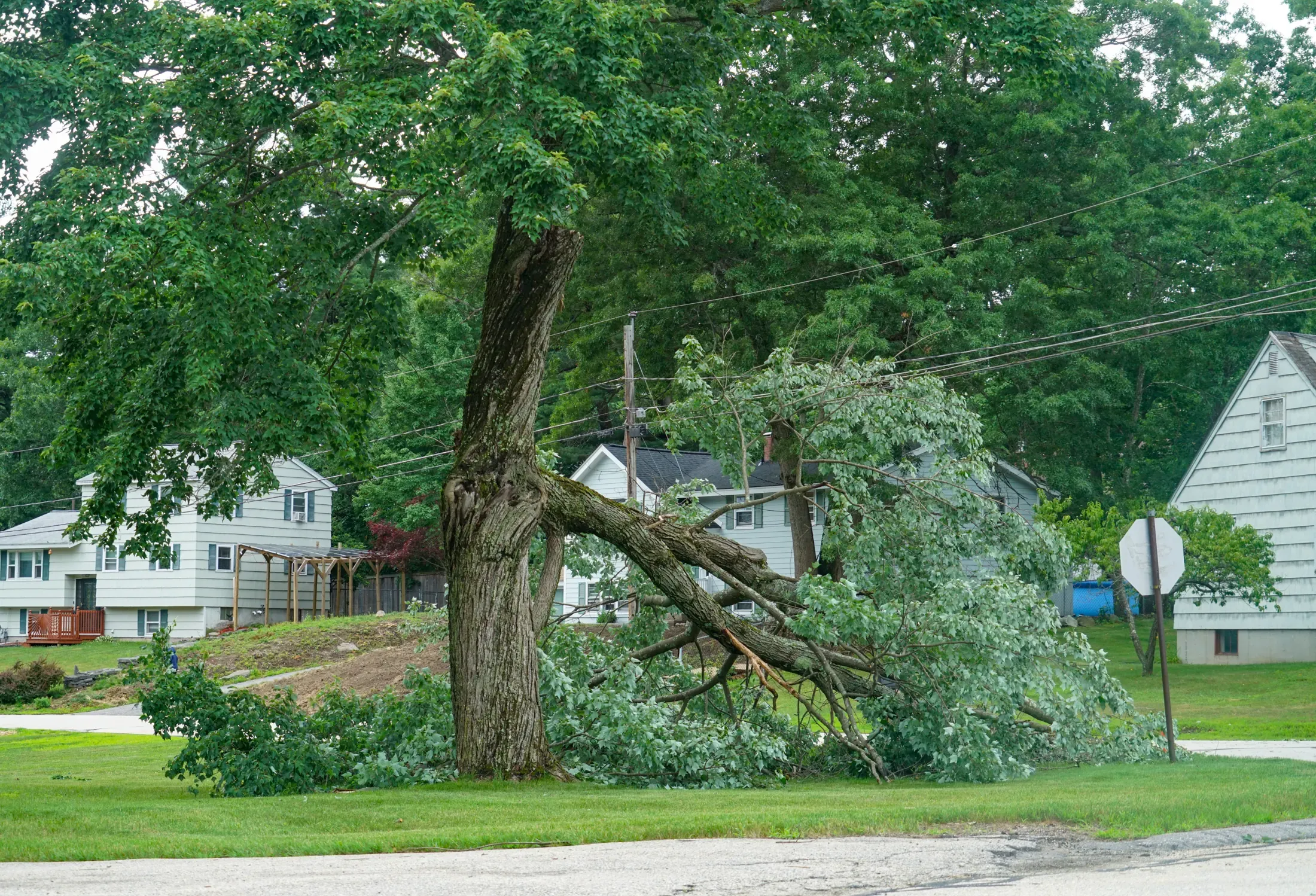
As of September 2026, the signs that an Amarillo, TX tree is a storm-failure risk are a lean with lifted or cracked soil on the opposite side, a crack or split in the trunk or a main union, large dead limbs over a target, fungus at the base, a hollow trunk, and a heavily one-sided canopy. Any one of those over a house or a driveway is worth a call before the next front; two or more together is a tree that shouldn't wait.
Panhandle Tree Care · (806) 555-0142 · matching Amarillo-area homeowners with independent local tree service providers.
Trees in Amarillo don’t usually fall out of a clear sky. They fall in the front that comes through at two in the morning in late April, or the September storm that nobody expected in a dry year. Almost every one of them was giving signals for months beforehand. The point of this guide is to help you read those signals in your own yard, on a calm day, while you still have options.
Why the Panhandle is different
Plenty of tree-safety advice is written for places with deep soil and steady rain. The Texas Panhandle is neither, and it changes what you should worry about.
Start with the weather. The Panhandle has a primary hail season from March through early May, peaking in April and early May, and an unusual secondary season in September and October, with smaller stones and more isolated storms. The spring fronts that bring the hail also bring strong straight-line wind, and that wind, not the hail, is what takes trees down: a warm afternoon, a line of storms to the west, and then twenty minutes of wind that finds every weak union in the neighborhood.
Then the dryness. The National Weather Service’s climate narrative for Amarillo describes roughly 19.71 inches of precipitation a year and relative humidity that occasionally drops below 15 percent, with temperature swings of 50 to 60 degrees inside twelve hours. Trees living through that are stressed in a way trees elsewhere are not. Drought-stressed wood is more brittle, dieback is more common, and a tree that was marginal in a wet year can be dangerous after a dry one.
Finally, the ground. Across much of Potter and Randall County, a chalky calcium-carbonate hardpan called caliche sits close to the surface. Roots can’t get through it easily, so they spread wide and shallow instead of deep. That gives tall trees a wide, flat root plate rather than a deep anchor. When the top few inches of soil get saturated by a spring storm and the wind loads a full canopy, that plate can rotate and the whole tree levers out, roots and all. It’s the failure mode that surprises people most, because the tree looked fine. We wrote more about this in the caliche guide.
So in the Panhandle you’re watching for three things: brittle wood that sheds limbs, dryness that kills wood from the tips in, and a shallow root plate that can tip a healthy tree.
Walk-around before the next front
This takes about fifteen minutes per tree, and it’s worth doing in the fall and again in early spring. Don’t climb anything, and don’t do it during or right after a storm; if a tree is visibly moving or freshly leaning, that’s a call, not a walk-around.
Step 1: Stand back and check lean and balance
Walk far enough from the tree to see the whole thing, and do it from each of four sides. Is the trunk vertical, or leaning? Is the canopy roughly balanced around the trunk, or is most of the weight on one side? A long-standing lean with a sound trunk is often fine; the tree has built wood to support it. A lean that’s new, or a canopy that’s heavily loaded toward the house, is what you’re looking for.
Step 2: Check the ground opposite the lean
If there’s any lean at all, walk to the side of the tree opposite the direction it leans and look at the ground. You’re looking for a crack in the soil, a raised hump, or turf that’s lifted like a rug. That’s the root plate starting to rotate. It’s the single most urgent sign on this list, because it means the tree is already moving.
Step 3: Check the base for fungus and cavities
Get down and look at the root flare, where the trunk widens into the ground. Mushrooms, shelf fungus, or a soft, punky area at the base mean decay in the part of the tree that carries all the load. Look for cavities, old wounds that never closed, and carpenter ants, which don’t cause decay but do move into it.
Step 4: Check the trunk and main unions
Follow the trunk up to where the first big limbs branch off. Look for cracks, especially vertical ones that run through a union. Look for seams where two stems meet in a tight V with bark folded inside instead of a raised ridge of wood; that’s included bark, and it’s a weak joint waiting for a load. Look for old splits that have partially closed, and for sap or dark streaking below a union.
Step 5: Look up for dead limbs over targets
Scan the canopy for limbs with no leaves in season, bark peeling off, or that are clearly a different color than the rest. Note where they’d land. A dead limb over the lawn is a chore; a dead limb over the roof, the driveway, or the neighbor’s fence is a job.
Step 6: Note what’s within reach
Pace out roughly the height of the tree in each direction and note what’s inside that circle: the house, the garage, cars, fences, the play set, the service drop from the pole, the neighbor’s roof. This is what turns a “tree with a problem” into a priority.
Step 7: Photograph and date everything
Take photographs of the whole tree from each side, the base, every union you’re unsure of, and any soil movement, and make sure the date is on them. Do it again in six months. A crack that hasn’t moved is a very different thing from a crack that has, and photographs are the only way you’ll know.
Species specifics
Knowing what kind of tree you have tells you what kind of failure to expect.
Siberian elm. The big, rough-barked tree in Amarillo’s older neighborhoods, and the one Wolflin is known for. Siberian elms grow fast, tolerate the Panhandle, and shed big limbs. The wood is brittle, and the unions on mature trees are commonly weak. The typical failure is a large limb, not the whole tree, and it comes down in a spring front. Regular deadwooding and reducing weight over the house is the maintenance pattern that keeps them.
Cottonwood. Common on Bushland acreage and along old draws. Cottonwoods want more water than Amarillo gives them, grow fast, and hollow with age. The typical failure is at an old wound, where the trunk or a big limb has rotted from the inside behind bark that still looks intact. If you can push a screwdriver into the base, or if there’s a big old cavity, assume there’s less solid wood than it looks.
Topped trees. Any species that was cut back hard to stubs years ago. Topping produces a flush of long, fast sprouts that attach only to the outer wood of the stub, and they fail readily once they’re big enough to catch wind. If your tree has a ring of long vertical shoots coming off blunt cut ends, it’s a topped tree, and those shoots are the limbs most likely to come down.
Austrian pine. Widely planted here because it handles the dryness. The failure mode to know about is the whole top: a dead or weakened leader that snaps out in wind, sometimes taking a large section with it. Watch for browning from the top down and for a leader that’s a different color than the rest of the tree.
Hackberry, honey locust, mesquite. Generally better structured for this climate and less prone to dramatic failures. They still sit on shallow root plates, so the walk-around applies, but they’re usually not the tree keeping you up at night.
“Will lose limbs” versus “will fall”
It helps to separate two different risks, because they call for different responses.
A tree that will lose limbs has problems in the canopy: dead wood, a weak union, a heavy limb over the house. The trunk and root plate are fine. The fix is pruning: get the dead wood out, reduce the weight where it matters, and the tree stays. This is most Siberian elms in town.
A tree that will fall has problems in the structure: a hollow base, decay at the root flare, a crack through the trunk, or a root plate that’s moving. Pruning can lighten the load and buy time, but it doesn’t fix the reason the tree might go over. This is the case where removal is on the table.
Near a house, both matter, because a big elm limb through the roof does plenty of damage even if the tree is still standing afterward. But knowing which one you’re dealing with tells you whether you’re calling about a trim or about a removal, and that shapes the cost, the urgency, and who you should have look at it. The trim-or-remove guide goes deeper on that decision.
What you can do before a storm
If the walk-around turned up canopy problems on a tree with a sound structure, there’s a lot that can be done, and the dormant season before the March hail season is the time.
Have the dead wood removed. Dead limbs are the most predictable failures, and taking them out is the cheapest safety work there is. Any competent tree service can do it.
Reduce the weight over the house. A crown reduction, done by cutting back to laterals rather than to stubs, makes the tree smaller and less of a sail without the weak regrowth of topping. Ask for a reduction, not a topping, and ask how much they intend to take.
Ask about cabling or bracing. For a valuable tree with a weak union that’s otherwise worth keeping, an arborist may propose installing cables high in the canopy or a brace rod through the union to limit how far the parts can move against each other. It’s a specialist job, it needs periodic inspection, and it’s not right for every tree. The point here is only that it exists, so if you’re told a tree with one bad union has to come out, you can ask whether cabling is an alternative.
Get the quote in writing. Whatever you have done, get the scope and the price on paper before the day. Local companies publish trimming at $100–$1,200 per tree; where your tree lands depends on size, access, and how much comes off.
What you cannot do
Don’t cut a leaning tree yourself. A leaner is under load, and the wood does unpredictable things when it’s cut. A trunk can split up the middle, kick backward, or roll. It’s not a chainsaw-skill problem; it’s a physics problem.
Don’t top the tree. Cutting the whole canopy back to stubs feels like it makes the tree safer. It does the opposite over a few years, because the regrowth is weakly attached and grows fast, and the stubs decay. If someone offers to top your tree, that’s a reason to get another quote.
Don’t trench the roots for a patio, driveway, or sprinkler line. With roots spread wide and shallow above caliche, a trench on one side of a tree can cut a large share of its anchoring. A tree that was stable for forty years can go over in the next front after the patio goes in. If you’re building near a mature tree, have someone look at the root zone first.
Don’t let anyone work near a line. If a limb is in or near the electric service, that’s Xcel Energy’s call, not a private crew’s. Line clearance is the utility’s job, and a homeowner shouldn’t have a private crew work within reach of an energized line.
What to do after the storm
If the front gets there first, the order of operations matters. Stay clear of anything touching a line and call Xcel Energy. Get people out of rooms under a tree that’s on the roof. Photograph everything from a safe distance before anything is moved, and call your insurer before you call a tree service. Then get a written price for the emergency work before it starts, because after-hours and crane jobs carry a premium over standard rates and you want that number on paper.
The emergency and storm-damage page walks through those first-hour steps in detail, including what to ask a crew that shows up unannounced after a storm.
When to call
If the walk-around found any one of the six signs in the direct answer over a house, a car, or a neighbor’s property, it’s worth a call before the next front. If it found two or more together, or any soil movement at all, don’t wait for the season.
For a tree you’re unsure about, the dying-or-dangerous checklist helps you sort what you’re seeing before you talk to anyone. When you do call, Texas doesn’t license tree services, so ask for a certificate of general liability insurance and workers’ comp, and ask whether anyone on the job is an ISA Certified Arborist. If the answer turns out to be removal, tree removal in Amarillo runs $400–$2,000+ per tree, with the top of the range for the big trees next to houses that this guide is mostly about.
FAQ
How to Tell If a Tree Will Fall in a Storm: A Panhandle Walk-Around: Questions Amarillo Homeowners Ask
What are the signs a tree is going to fall?
The clearest signs are a lean with the soil lifting or cracking on the side away from the lean, a crack or split running through the trunk or a main union, a hollow you can see or probe into, and fungus growing at the base. Large dead limbs and a canopy heavily loaded to one side raise the odds of a limb or a whole-tree failure in wind. None of these guarantee a fall, but each one over a house or a car is worth having looked at before storm season.
Can a healthy-looking tree fall in a storm?
Yes, and in the Panhandle it happens most often with tall trees on shallow root plates. Caliche sits close to the surface across much of Potter and Randall County, so roots spread wide rather than deep, and a tall tree with a full canopy can lever out of saturated ground in a strong spring front even when the trunk is perfectly sound. That is why lean, soil movement, and canopy balance matter as much as visible decay.
Should I trim my trees before storm season in Amarillo?
Generally yes, if there is dead wood or heavy limbs over a target, and the dormant season in late fall and winter is the practical window before the March through early May hail season. Removing dead limbs and reducing weight over the house takes the most likely failures off the table. What you should not do is top the tree, which produces weak regrowth that fails more readily in the following years.
Which trees in Amarillo are most likely to fall or drop limbs?
Siberian elms, common in older neighborhoods like Wolflin, are brittle and commonly shed large limbs in wind. Cottonwoods, common on Bushland acreage, tend to hollow with age and fail at old wounds. Trees that were topped in the past regrow weak, poorly attached wood, and Austrian pines can drop whole tops. Hackberry and honey locust generally hold up better here, though any tall tree on a shallow root plate can lever out.
What should I do if a tree falls on my house during a storm?
Get everyone out of the rooms under the tree, and if any line is down or the tree is touching a line, stay away and call Xcel Energy before anyone else. Then call your insurer, photograph everything from a safe distance, and only after that call a tree service. A crew should not work within reach of an energized line, and a tree resting on a roof needs to be taken off in pieces, not pulled, so don't let anyone rush that part.
How much does it cost to remove a tree that might fall?
A standing removal in Amarillo runs $400–$2,000+ per tree, with the top of that range for large trees near a house or power line. If the tree is already down with clear access, the job can actually cost less than a standing removal, while after-hours, same-day, or crane work carries a premium over the standard tiers that you should get in writing before the work starts.
Keep reading
Related Amarillo tree guides
Ready for a real quote from a local Amarillo tree service?
Tell us what your tree is doing and we’ll match you with an independent local provider serving Amarillo, Canyon, and Bushland. No obligation to hire.